
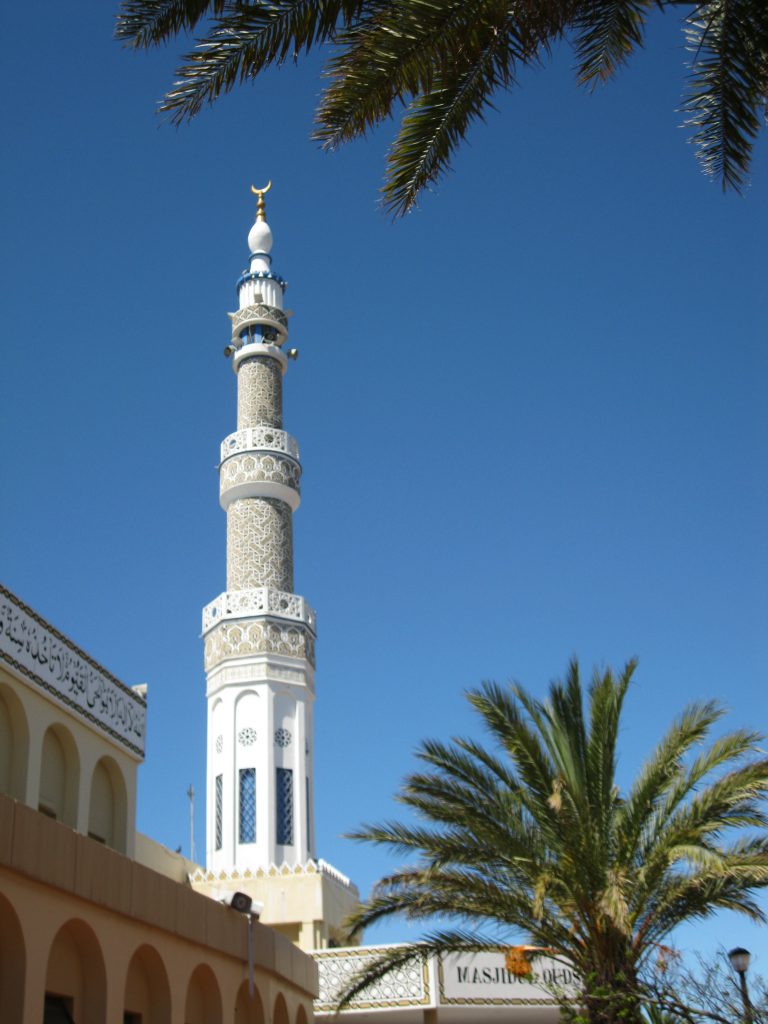
Minarets are harbingers of prayer. Over ime they have also become iconic symbols of Islam. These fascinating fingers of faith reach to the skies, and from their heady balconies come the athan (call to prayer). The bilal’s (reciter’s) voice, unique intone and musicality, remind the faithful to heed the five daily salaahs (prayers). That will soon be in the past. Minarets are now adorned with loudspeakers blaring across the airwaves. In some rural areas, the daily athans are still recited by living, breathing souls; sadly in many cities they are mere recorded recitals, impoverished of warmth and spirit.
The lore of minarets is fascinating. We have briefly gone into that in previous columns, but let us linger a while longer in their shadows before they go silent and vanish into the dust of history. But where did it all start?
In old Medina Christians rang bells to summon the flocks to services. Jews blew the shofar (ram’s horn) to invite the faithful to prayers. Abd Allah ibn Zayd, a companion of the Prophet Muhammad (PBUH) dreamt that he saw someone call Muslims to prayer from the roof of a mosque. He told the dream to the Prophet who then instructed Bilal, a freed Abyssinian slave, Muslim convert and famed for his beautiful voice: ‘Rise Bilal and summon all to prayer’. (Aramco World 2002). He became the first muezzin (Arabic: mu’adhdin, one who gives the adhan).
Traditionally the call to prayer was delivered from the flat roof of a mosque, or some other elevated place. High platforms specially erected above the normal roof heights were condemned when it was said that the bilals could spy into the surrounding household compounds, so invading individual privacy. It is said that Ali ibn Talip, the Prophet’s cousin, and later Caliph, ordered these to be destroyed. In later years some mosques compromised and used blind muezzins to recite the athan from raised structures.
Why the necessity for an athaan-call for each prayer? Given that the five daily prayers are spread over both day and night, the faithful needed to be aware of the time of each. In nascent Islamic days, measuring time, especially in rural and desert areas, was problematic. Simple time measurement was effected by placing a stick in the desert sand and observing the thrown shadow (Sundials). This was only good for clear sunny days. Hour glasses used the flow of sand between chambers; water clocks depended on water dripping at a certain rate. Vocal athans were therefore imperative.
The first mechanical clock was invented by Yi Xing in China 725CE. But mechanical clocks were expensive, scarce and inaccurate. Pendulum and spring watches changed this. Modern quartz crystal clocks are very accurate and relatively cheap. Today’s ytterbium atomic clocks are accurate to less than two parts in 1 quintillion (2×10⁻¹⁸) years. Electronic athan via watches and cellphones is gaining popularity. In fact, electronic alarm clocks have made observing prayer times so easy that the voiced athan from minarets athaan is no longer an absolute essential.
The athan when recited by human voice exclusively is often beautiful on the ear and the senses. Extremely loud amplified noise of any kind is painful to all ears. It can be relegated as nuisance. Unfortunately the overloud amplification of the athan by insensitive Muslims is common at all hours of the day and night, particularly in the holy month of Ramadan when we are asked to be kind, gracious and considerate to others of all faiths. I have experienced this. My window-panes have at times rattled loudly even though I live almost a kilometre from the nearest mosque. Muslims, especially those living in predominately non-Muslim societies, should be thoughtful and caring to their neighbours, the sick, sleeping babies and the infirm elderly at all times.
It is emphasised that, it is not the athan that is berated; it is the inconsiderate amplification. This uncaring attitude has resulted in some non-Muslim countries banning the athan via loudspeakers, and sometimes even forbidding the erection of minarets. France has been particularly firm on loud athan recitations. In Switzerland building of minarets was forbidden in some towns, even though in a referendum on it, more than 50% of citizens did vote for it to be banned. In the English city of Oxford in 2008 plans to build a mosque with a minaret caused an outcry against the amplification of the athan, and a delay in the erection of the mosque. PS: Just after the column was finished, I read a report in The Times 23-11-2016 headed: ‘Last Call before the plug is pulled’. ‘A bill backed by Israeli Prime Minister Benjamin Netanyahu to ban mosques from using loudspeakers late at night and early morning for calls to prayer has been approved by a ministerial committee.’
Minarets are not mandatory to modern mosques. In fact, in years past, most mosques in Malaysia and Indonesia did not have minarets.
Recently I noticed in greater Cape Town two mosques that have minarets serving a dual purpose: firstly for the recitation of the athan via speakers, and secondly for housing the antennae of cell-phone companies such as Cell-C etc. Cassiem Slamang kindly pointed the different antennae to me on the minaret of the Taronga Road Mosque, in Crawford. This is admirable. Many large mosques in the old Middle East, North Africa and Turkey served not only space for prayers but also facilities for commercial enterprises such as caravanserais where caravans of camels could outspan and the caravaneers offered rest and victuals. The Süleymanye mosque in Istanbul had Hamam-bathing facilities and hospital rooms. Mosques need upkeep and running expenses, and using minarets is a forward thinking idea of generating of income for the mosque.
So, the athan is a blessing for Muslims. But, like all blessings they have to be savoured with love and compassion. Turning up the volume to hurtful levels is abuse to both Muslims and non-Muslims. It can sour public relations, shatter peace and harmony. This sin is abhorred in Islam.
In the next column we shall marvel at the medley of minarets across the world.
Featured Image: Taronga Road Mosque minaret. Note the speakers and the Cell-Phone antennae.
© Copyright M. C. Dharsey (D’arcy) August, 2016