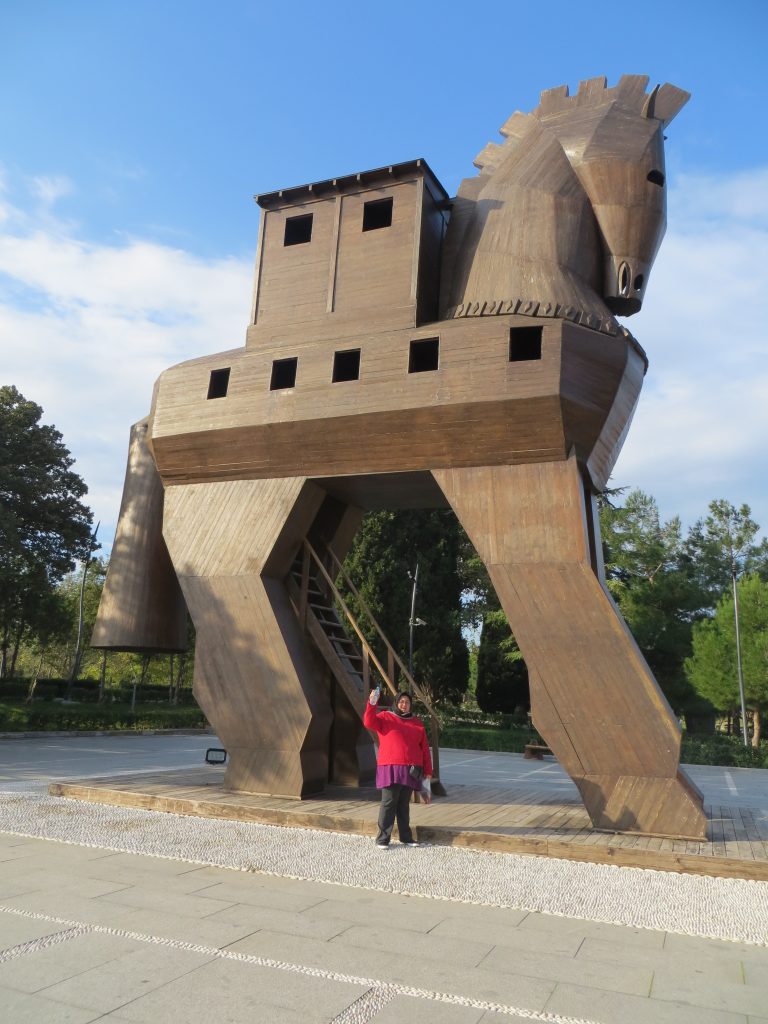
(Shameema Dharsey at the Wooden Horse at Troy ‘replica’ for tourists. © Photo: M. C. D’arcy
The giant wooden horse stands silent amongst the excavated ruins of Troy; its sleek beauty belies its sinister historic intent. This modern horse is for tourists. But, once long ago another wooden horse, a ‘gift from the Greeks’, spelled death by fire and sword of a vibrant incarnation of the glorious city of Troy, Queen of Asia Minor, in what is now Turkey. This Troy goes back to 1600 BCE, its history tumultuous, but only the Trojan wars of love, lust and betrayals, as extolled by the blind Greek historian and poet Homer in his Iliad and Odyssey epic poems, live on today; a favourite subject of the movies.
The great Trojan War, cited in the Iliad, erupted when Paris of Troy lured the Greek beauty, Helen, away from her husband, Menelaus, king of Sparta, sited a marathon distance away from Athens. In revenge, Agamemnon, brother of Menelaus, besieged Troy. The city bravely resisted even though its heroes, Paris, Ajax and Hector were killed in a skirmish. Achilles was killed, shot in his heel, his only weak spot. But the Greeks could not breach the walls of Troy. In a clever ruse, they left a huge wooden horse filled with soldiers outside the gates of Troy late one afternoon. The unsuspecting Trojans dragged the horse inside the gates and left it overnight. With darkness the soldiers exited the belly of the wooden horse and opened the city gates. The Greek armies poured in, slaughtered the Trojan men and enslaved the women and children. They desecrated the sacred temples and were cursed for it; only a few Greeks returned home safely. A surviving Trojan, Aeneas, fled to modern-day Italy. The ancient Romans traced their ancestry to Aeneas.
This war gave us: ‘As beautiful as Helen of Troy,’ ‘Beware of Greeks bearing gifts’ and ‘His Achilles heel is his eye for pretty women.’
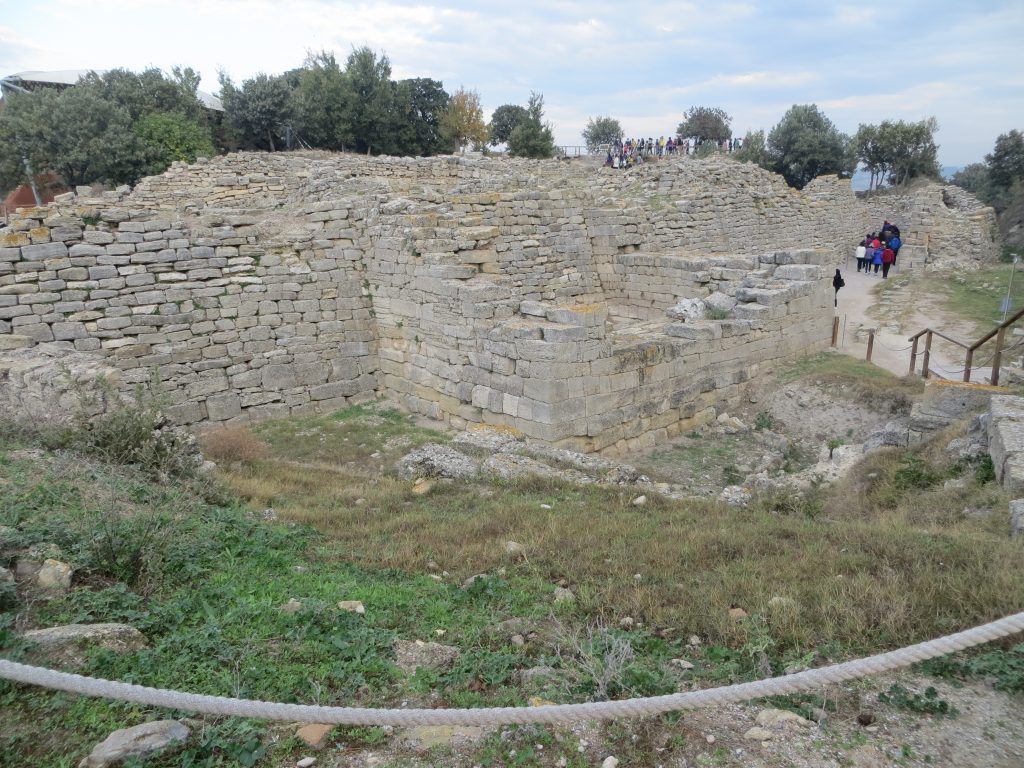
The excavated walls of Troy. There is no certainty as to which Troy era this represents. © Photo: M. C. D’arcy
Extensive excavations at Troy show more than nine different strata (layers) and each layer represents an epoch in the life of Troy. With time all these layers were buried under shifting sands and mud until there were only a few grass covered hills. Homer’s Iliad was shelved as mere myth and fiction.
Homer and the Greek philosophers, such as Socrates and Plato, would have been buried in history had the medieval Muslim scholars of Baghdad, Damascus and Egypt not translated and catalogued the works of the ancient Greeks. It is through their work that modern scholars are able to access the historic wealth of Hellenic civilization, and it stirred western scholars to research the past, dig up historic sites such as the ‘mythical’ city of Troy and Homer. The modern discovery of Troy is fascinating.
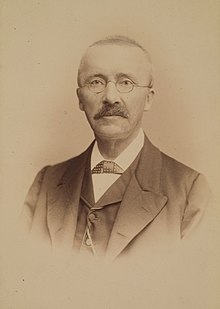
German archaeologist, Heinrich Schliemann, who first excavated Troy in Turkey during the nineteenth century.
(Schliemann-Wikipedia)
History is often an accretion of facts heavily spiced with fiction. This is probably what German-born Heinrich Schliemann’s life was all about. He is credited with discovering the site of the ancient Troy of wooden horse era, and the gold Treasure of Prium, but various sources decry these claims.
Born in 1822, Heinrich Schliemann boasted that from the age of 8 years he knew that he would uncover ancient Troy. Unlikely. Many of his other claims stretched truth to breaking point. But he was a brilliant linguist able to learn a language in six weeks. He conversed in English, French, Dutch, Spanish, Portuguese, Swedish, Polish, Italian, Greek, Latin, Russian, Arabic, Turkish and German. In 1869 he was awarded a doctorate for a dissertation on the topography around Hissarlik, asserting that it was the site of Troy. Like the current rash of ANC and Grace Mugabe phantom PhD’s, it is said that he borrowed large sections of the thesis from other people’s work.
But, Schliemann apparently did have a flamboyant life worthy of a movie, including surviving a shipwreck in a violent storm. He was a wily businessman, retiring rich at the age of 47. When his rocky first marriage ended, he advertised for a Greek wife who could translate ancient Greek for him. In 1869 he and his 17year old Greek bride, Sophia Engastromenos, fruitlessly excavated at Pinarbasi in Turkey, thought to be the site of Troy. Frank Calvert, a local archaeological expert, and owner of land at Hissarlik, suggested that Schliemann excavate on his land. And the rest is history. An untrained archaeologist, Schliemann excavated like a bull in a China shop destroying valuable evidence.
Art is crucial in archaeology. Inscribed stone pillars and friezes, sculptures, pot shards (broken pieces), coins dated or decorated with effigies of kings and jewellery patterns, can be very helpful in deducing the age of certain layers. In this case, they searched for an ash layer of the Troy that was burnt to the ground. Carbon-14 assay of wood ashes can, with some accuracy, indicate when the wood burnt. The site probably was that of Troy, but there was no ash-evidence that it was the Troy that was burnt to the ground during the Trojan wars of the wooden horse.
So, the mystery of the Illiad’s Troy story lives on, unblessed with certainty.

Prium’s Treasure displayed by Heinrich Schliemann’s wife. The Treasure is now housed in the Pushkin Museum, Moscow. There is no proof that it is the Treasure of Prium.
(Prium’s treasure- Wikipedia)
Heinrich Schliemann’s story of the treasure of Prium, King of Troy, is thought to be a fruitcake of fact and fiction. Whilst Heinrich was digging around, his wife, Sophia, spotted something glinting in the sand. She called her husband and to their joy they found a bundle of gold jewellery. Heinrich covered it up and dismissed his gang of assistants. That evening they came back and uncovered a hoard of fine gold jewellery which Sophia carried away in her shawl. Heinrich called it the Treasure of Prium. Sounds wonderful, except that Sophia was back in Athens at the time the jewels were discovered. There’s no proof that it was Prium’s jewels.
The treasure trove was smuggled out of Turkey and displayed in the Pergamon Museum in Berlin. In 1945 the Soviet-Russian army took the jewels to Moscow where it is now housed in the Pushkin Museum.
Often stories of discovery are so exciting that one wants to believe it as truth; the world of science demands tangible proof. Most times there is none. People laughed and gasped in wonder that Sinbad, the sailor, depicted in the Tales of the Arabian Nights, flew on the back of a giant Roc bird (Persian: Rukh) high up into the sky. It was just a story. Yet, today we know that there was once a flightless bird, 3 metres tall and weighing over 400kg, on Madagascar called the Aepyornis (Elephant Bird). Its egg weighed over 10kg (equivalent to 160 hen’s eggs). I remember a newspaper report a few decades ago stating that a small boy had found an Aepyornis egg on the beach in West Australia. The Aepyornis probably became extinct in the 16th Century.
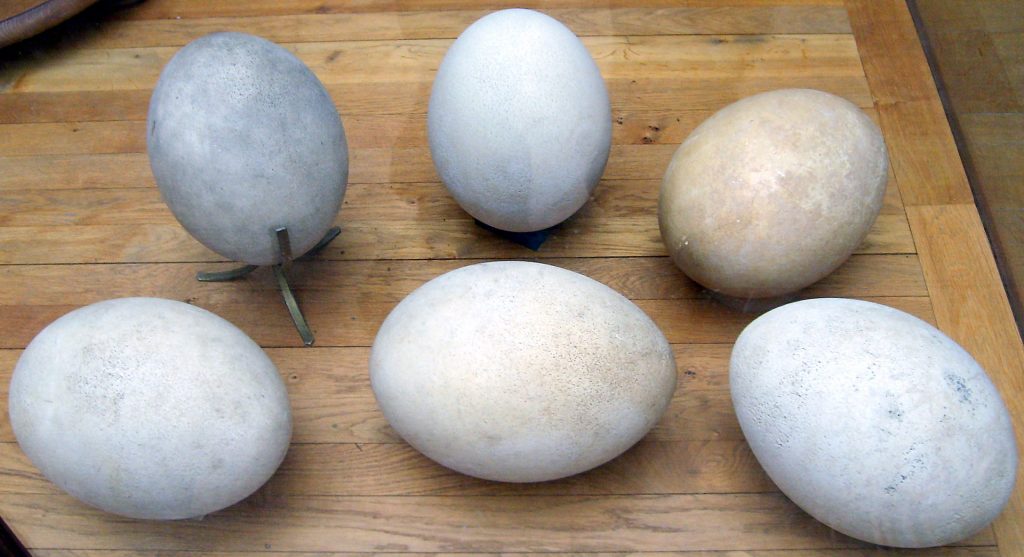
Aepyornis egg from Madagascar. Sinbad the Sailor of fiction and myth was carried off by a giant bird-the Roc. (Wikipedia)
The Aepyornis was many times bigger than an ostrich; and, as we well know in South Africa, ostriches can race along with a full grown man on its back.
Was there really a Roc that could fly with a man on its back? And, was the Troy of the Wooden-horse story a real place? What is myth and what is history? Who can tell?
Aside: Quoted in Wikipedia, Homer said:
1. Hateful to me as the gates of Hades is that man who hides one thing in his heart and speaks another.
2. The difficulty is not so great to die for a friend, as to find a friend worth dying for.
© Copyright: M. C. Dharsey (D’arcy) – 13 December to 2015 to 23-2-2016, Word Count: 1187.