
Half the magnetism of a masterpiece is its history; physical aesthetics complete the other half. Jerusalem’s Masjid Aqsa affirms this. Its history is daunting, replete with nasty political storms, bloody wars, frequent damage by earthquakes, incendiary lunatics and, of course, bitter controversy. But its aesthetic beauty is sublime. Mr Niezaar Abrahams requested this brief narrative that really needs volumes to do it justice.
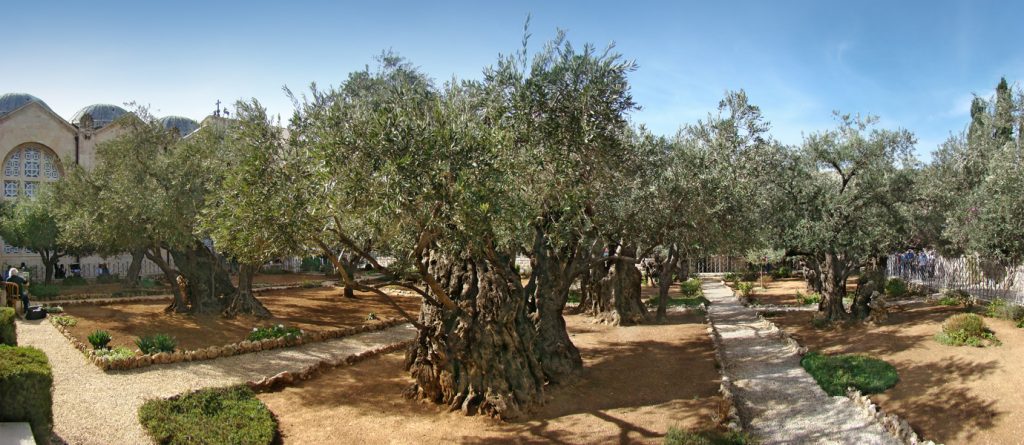
Thousand year old Olive trees in the garden of Gathsemene near the Dome of the Rock. (Wikipedia)
Many years ago I stood in Jerusalem’s Garden of Gethsemane on Mount Olives, surrounded by a small grove of gnarled olive trees, some more than a thousand year old. Rising from the adjacent deep Kidron valley, was a rectangular flat- topped hill clad with a sand-stone wall. On it a marvellous blue-tiled octagonal building: The Dome of the Rock. Its shimmering golden dome glowed in the morning sun eclipsing all the other structures on the elevated al-Haram ash Sharif (the Noble Sanctuary) (Also called: Temple Mount). The Dome of the Rock is a supreme architectural confection built by the Umayyad Caliph Abd al-Malik in 671CE, almost 40 years after the death of the Prophet on 8th June, 632CE. Some contend that it was built as a religious and political rival to the Kaaba in Mecca.
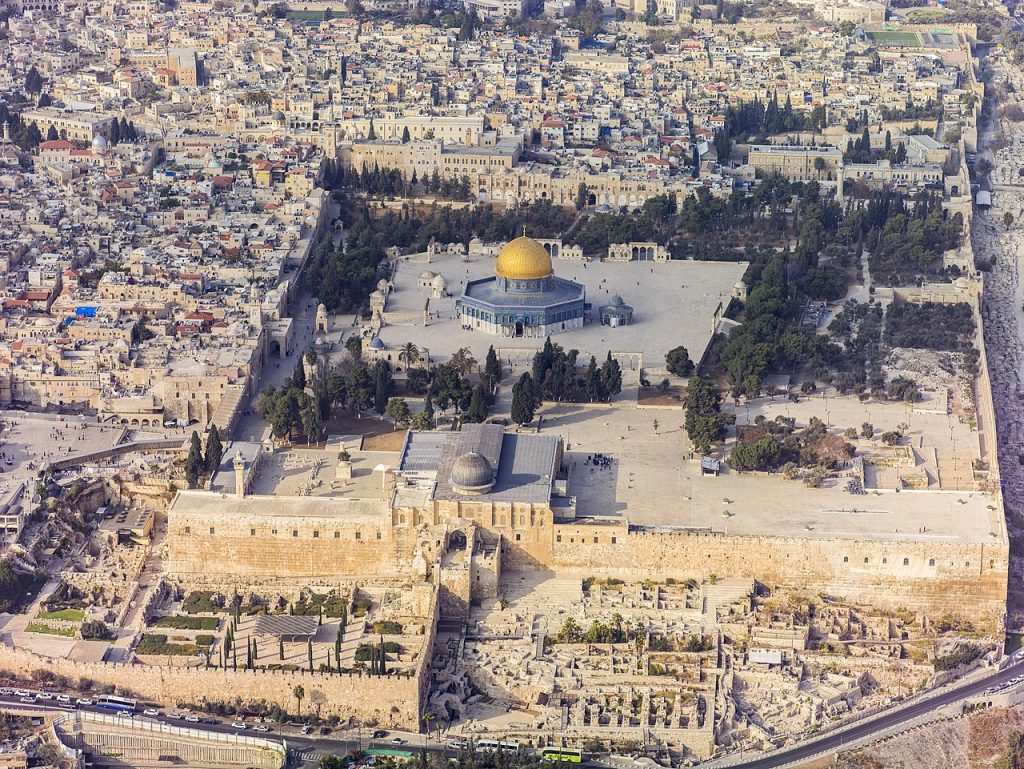
This is really the Dome of the Rock ambulatory built around a sacred rock of the Abrahamic religions. (Wikipedia)
The Dome of the Rock covers a sacred rocky outcrop revered by the three Abrahamic religions regarded as: The people of the Book: Judaism, Christianity and Islam. Most Muslims believe that it was from this rock that the Prophet’s heavenly journey or Miraj took place. Some early Muslims queried this assertion.
Following the conquest of Jerusalem by the Christian Crusaders in 1099 CE the Dome of the Rock was turned into a church. Masjid Aqsa was used as a palace and horse-stables. With the reconquest of Jerusalem by the Kurdish general, Salahudin Ayyubi (Saladin) in 1187CE, both the Dome of the Rock and the Masjid Aqsa were restored to their former glory. In the sixteenth century the outer walls of the Dome of the Rock were decorated with striking Kashani tiles by the Ottoman Sultan, Suleiman the Magnificent and his super-architect, Mimar Sinan,.
Technically the Dome of the Rock is not regarded as a definitive mosque, but as a circumambulatory for visitors to walk around the venerated rock.
Skirting the southern perimeter of the mount was a silver-domed mosque. This historic edifice is revered as Masjid Al-Aqsa, or the mosque of the Rashidun Caliph Umar, Companion of Prophet Mohammed.
For the first fourteen years the early Muslims turned to Jerusalem as their qiblah (direction of prayer). During the seventeenth month of Hijri, in the current Masjid Qiblatyn space, the Prophet switched the qiblah to the ancient venerated Kaabain Mecca.
At various times many Muslims regarded the whole ‘Temple Mount’ inclusive of both religious buildings as Masjid Aqsa. Others differed. They regarded the gold clad Dome of the Rock only as a place of reverence. The silver domed Umar -inspired mosque was called: Masjid Aqsa. Their histories are intertwined.
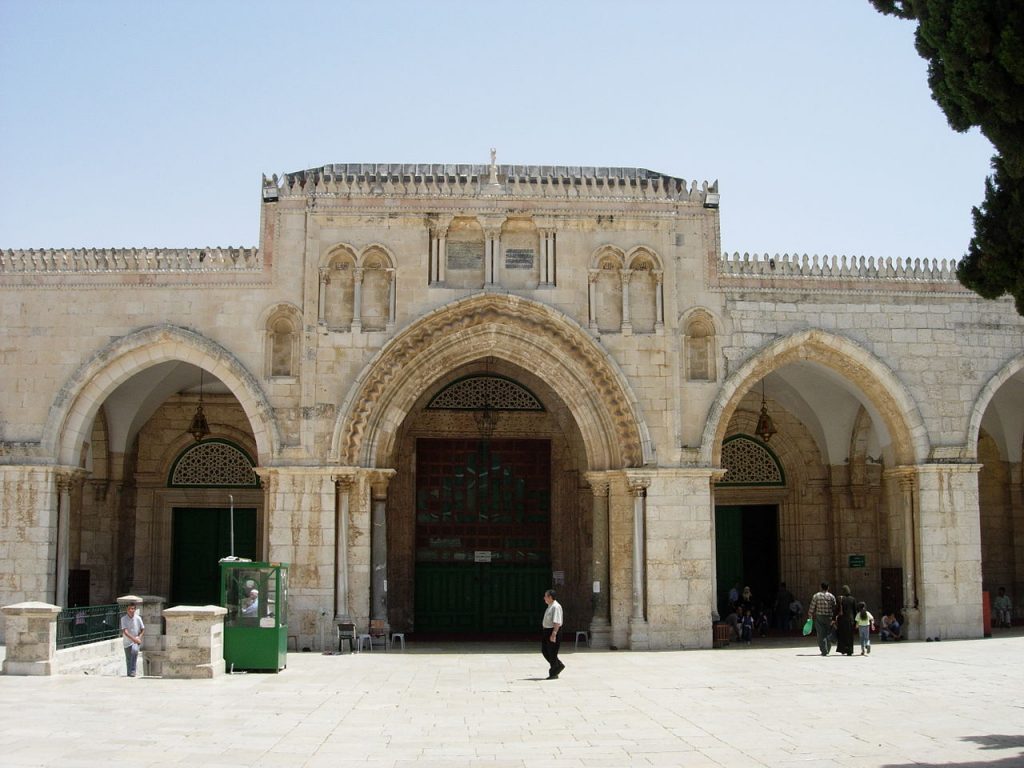
The real Al-Aqsa Mosque façade on Al Haram Ash Sharif –the Noble Mount. (Wikipedia)
Jerusalem is ancient, a city with a turbulent, somewhat bloody history. The city and its surrounds, now known as Palestine-Israel, were sequentially in the hands of the Egyptian Pharaohs, the Canaanites, the Persians, Babylonians and others, including the Aramaic-speaking Nabataeans with their striking rock-hewed capital city: Petra. Incidentally, Jesus and the early Christians purportedlyspoke Aramaic. Then came the Romans and the Byzantines.
According to Jewish lore, Temple Mount was the site of King Solomon’s Temple that secluded the Ark of the Covenant (Temple no 1). This ornate Ark was a wooden casket that held two stones inscribed with the Ten Commandments Moses had received from God. The Roman Emperor, Titus, destroyed Herod’s Temple (Temple no 2) on the mount in 70CE. According to historian Josephus, the Roman legions sacked Jerusalem and enslaved or killed large numbers of its population of Jews and early Christians.
The Romans ruled Palestine for the following 600 years. In 312CE Roman Emperor, Constantine, converted to Christianity, and shifted the Roman Empire’s capital to Byzantium. This city on the Bosphorus Straits became Constantinople (following the Ottoman conquest in the 15th century it became Istanbul). By the time the Muslims came on the scene in the 6th century, Palestine and Jerusalem were in the hands of the Eastern Byzantine Christian Empire. In 614CE their Emperor, Heraclius, had recaptured it from the Persians who had looted Jerusalem and massacred 90,000 Christians.
After the death of the Prophet, Caliph Abu Bakr carried on with the Muslim conquests. Abu Bakr died in 634CE. Caliph Umar’s armies routed the Byzantines at the Battle of Yarmouk in August 636CE. Muslim generals Abu Ubaidah and Khalid ibn Walid then marched to Jerusalem in November. After a four month siege Patriarch of Jerusalem Sophronius accepted a bloodless surrender on condition that the Caliph Umar came to Jerusalem to sign the peace treaty and accept the keys to the city. Umar arrived at Jerusalem in April 637CE and signed the treaty. ‘For the first time in 500 years of oppressive rule, Jews were once again allowed to live and worship in Jerusalem.’ (Wikipedia: Siege of Jerusalem 636-637CE). It is recorded that Caliph Umar refused an invitation from Patriarch Sophronius to perform Thur prayers in the Church of the Holy Sepulchre on the premise of the danger that some of his followers might break the treaty of the sanctity of worshipping places and build a mosque there. Caliph Umar cleared a rubble site on the ‘Temple Mount’ and prayed there. On this site rests the current ‘Masjid of Umar/Masjid Al-Aqsa.’ Umar stayed in Jerusalem for ten days, and then returned to Medina.
Arculf, a Gallic monk, wrote that in 679CE a primitive quadrangular wooden mosque with a capacity of 3,000 worshipers stood at the site of the ‘Umar mosque’. It is probably Caliph Mu’awiyah1 who had the mosque built.
According to Muslim scholars Muir ad-Din and al-Muqaddasi, Caliph Abd al-Malik reconstructed the mosque and built the Dome of the Rock in 691CE. His son, al-Walid completed it. In 713CE parts of the al-Aqsa mosque were destroyed in an earthquake. Abd al-Malik took gold from the Dome of the Rock, minted money with it to pay for Masjid Aqsa’s repairs. After another earthquake damaged the al-Aqsa mosque in 746CE Abbasid Caliph Abu Ja’far al-Mansur took gold and silver from the mosques gate-plaques for these repairs. In 774CE another earthquake struck. The damage was repaired by Caliph al-Mahdi. He had it rebuilt. Written accounts by Arab geographer al-Muqaddasi record that the new mosque had ‘fifteen naves and fifteen gates’. After the earthquake of 1033CE Fatimid Caliph Ali-Zahir completely renovated and rebuilt the mosque. A dome made of wood and overlaid by lead was added to the mosque, giving it a silver appearance.
Another catastrophe came in the form of the Christian Crusaders who had pillaged and raped their way across Europe to Jerusalem. As noted, Masjid Aqsa became a palace and a stable for horses. In 1178 Salahudin Ayyubi (Saladin) reconquered Jerusalem in 1187CE. He reconstructed the Al-Aqsa mosque and installed a magnificent hand-wrought minbar built by craftsman Akhtari from Aleppo that his predecessor Zengid Sultan Nur-al-Din had commissioned specifically for the time when Al-Aqsa mosque would be released from the Crusader yoke. In 1969 this beautiful minbar was torched by an ‘insane’ Australian, Michael Rohan, belonging to the Worldwide Church of God. He had hoped that it would expedite the second coming of Christ. In 2007, after a collective effort of many, including the genius Bedouin Jamil Badran, who drew the plans for an exact copy, a new ‘Akhtari’ minbar was installed. (My column: Stairway to Heaven in MV: July/Aug, 2014)
With the struggle for freedom of Palestine from the Israeli yoke, the Masjid Aqsa is under constant threat of harm and destruction.
The current al Aqsa is 83m long and 56m wide mosque and can hold 5,000 worshippers and is of early Islamic architecture design. It has a large silvery lead-enamel clad dome sited in front of the mihrab, its interior painted in 14th century style. There are several minor domes. It has a facade of 14 stone arches.
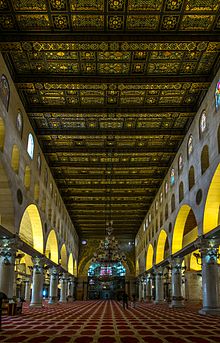
Inside the Al Aqsa mosque. Note the fat marble pillars of the central nave and their Corinthian tops. (Wikipedia)
The interior has seven aisles of hypostyle naves plus several small halls on both sides. 121 stained glass windows light the interior. 45 white marble columns hold up the roof. The columns lining the central aisle are short and squat; their capitals typically foliated Corinthian style. An old man guided me to one pillar and showed me a bullet mark on one of the columns. ‘That is where one of the bullets rested when King Abdullah of Jordan was assassinated in 1951.’
The Masjid Al-Aqsa is a very special place for Muslims all over the world. It has had a turbulent history. It is now threatened by Israeli excavation beneath the Temple Mount close to its very foundations. But it has withstood physical abuse and destruction by man and nature. Masjid al-Aqsa is indeed a living structure akin to the mythical Phoenix bird that rises from fire and ashes to fly again and again.
© Copyright: M. C. Dharsey (D’arcy) 13 November, 2016 WC: 1500