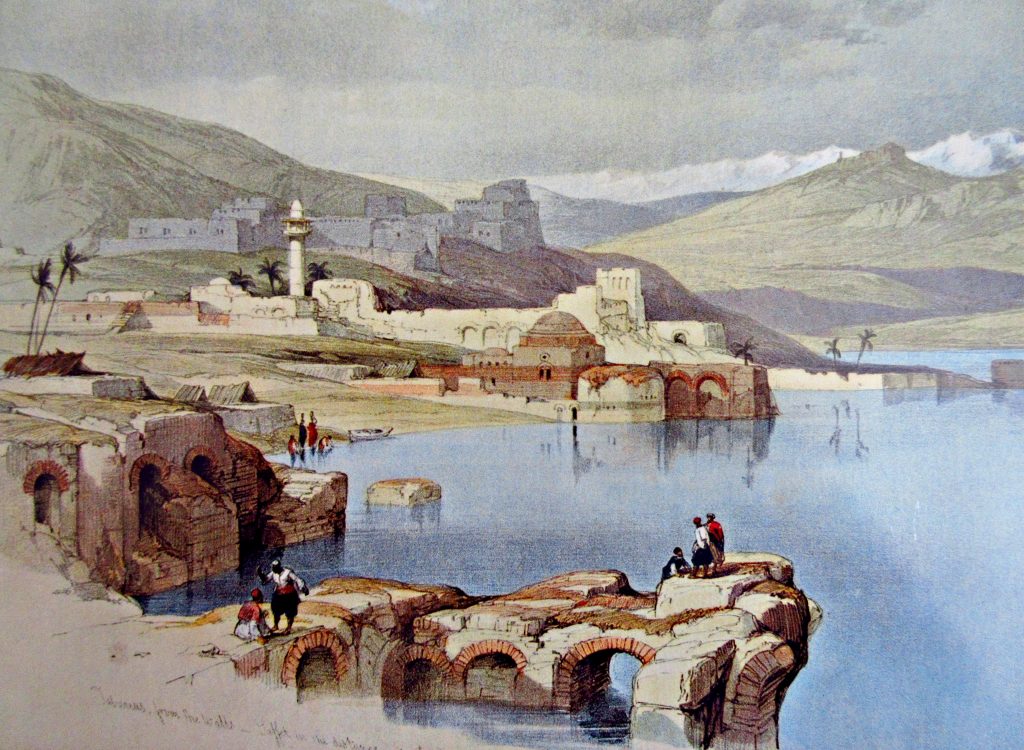
Should I? Or shouldn’t I buy it? I scratched my head. The elongated wooden frame held two pictures, one rather faded, the other glowing like yesterday’s muted sunlight, a little soft, suffused with gentle colours that caressed the eyes. I knew I had to look closer. The pictures were old. They depicted vistas of the far-off Sea of Galilee at the northern tip of the great Rift-Valley as it meanders through the Holy Land of ancient Palestine. The limpid sea reflects the surrounding hills, palms, a mosque and a distant fortress. Tiny figures dot the foreground lending measure to the epic landscape. It was gourmet-art to savour slowly.
Below the pictures were annotated the artist’s name, David Roberts, and that the medium was a colour lithograph dated 1839.
These two framed lithographs were an exciting find, for I had written about the work of the Orientalist artists of Victorian Europe who recorded Egypt, the Middle East and the Islamic world at a time when photography was in its infancy and watercolour depiction of exotic scenes was the only source for visual access to the Eastern world. A magnificent lithograph of the Temple Mount and the Dome of the Rock by David Roberts accompanied the article in Muslim Views.
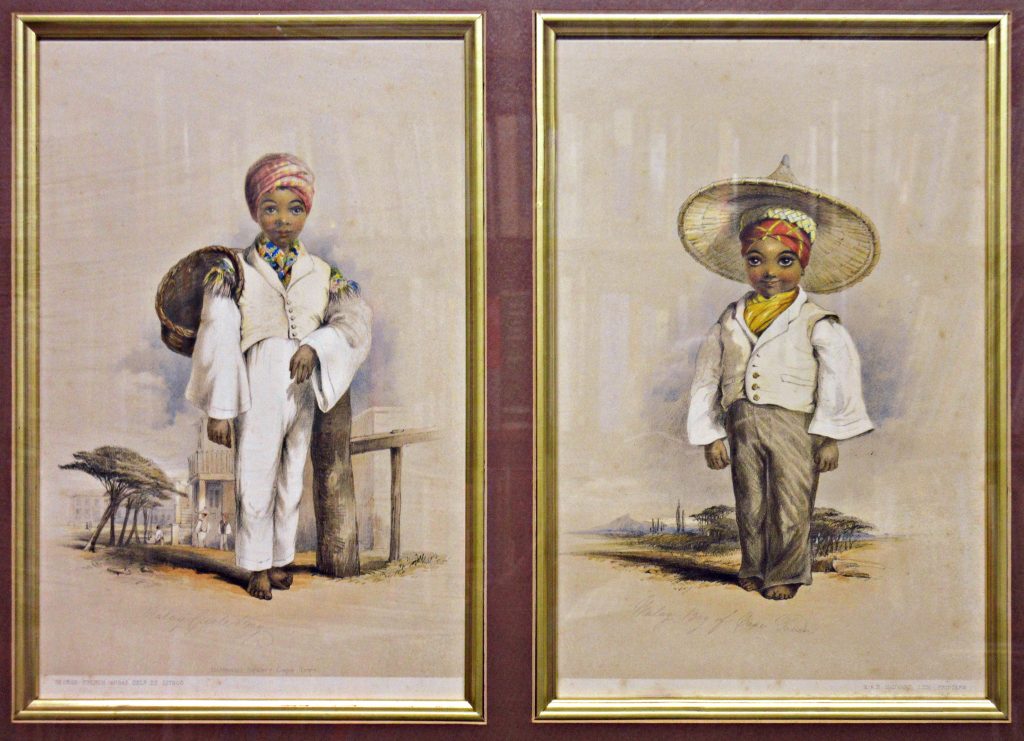
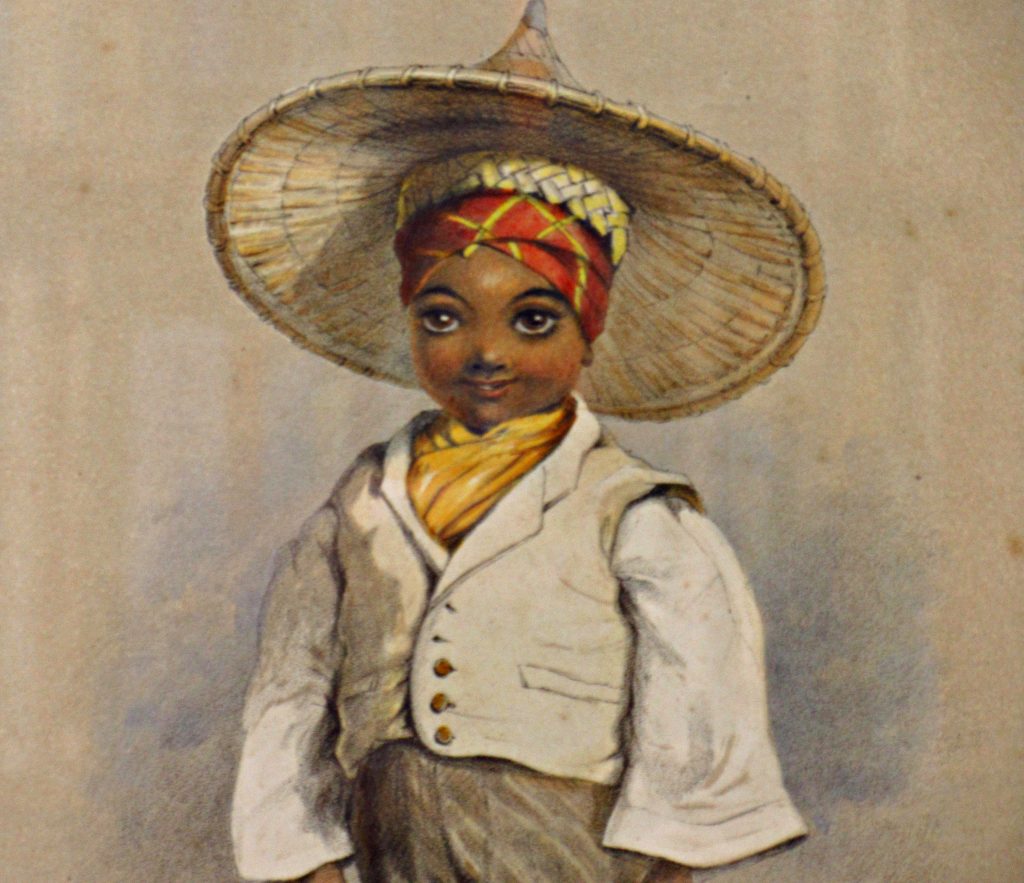
I had also written about the famous lithographs of James French Angus who had been in Cape Town during the 1840’s and produced the wonderful pictures of the Muslim madrasa, the portraits of two young boys in the typical dress of the times, and also the famous portraits of Nasiera and Imam Abdullah that were signed in Arabic by the subjects themselves. I was fortunate to have procured original lithographs of some of these pictures and treasure them as heritage gems as well as artistic masterpieces.
And strangely, despite the ridiculously cheap price-sticker of the David Roberts lithographs, muddle-headed I walked out of the bookshop empty-handed. I kicked myself when I got home. I went back a few days later praying that the frame and its gems were still there. It was my lucky-moon day. I now have them, the dust brushed away and there for me to savour at leisure.
What are lithographs? Lithography is the process of producing pictures via the use of plates and pressure by blocks of heavy stones to produce images on paper. It’s a complex, somewhat tedious process. The usual result is a mono-colour black image. The production of coloured images is even more exacting. The image has to be printed in each colour precisely so that it can produce a homogeneous artwork. The first lithographs were produced around 1790. It was superseded by black and white photography around the 1830’s. Photographs had to be hand coloured. I can still remember how I hand-coloured black and white Kodak Brownie pictures on our kitchen table in the 1950’s.
David Roberts was born in Scotland. At 10 years he was apprenticed to a house painter. He studied art at night. Later he went from painting scenery for a circus to producing scenic backdrops for theatres. He steadily progressed to painting art canvases and exhibiting these. The great British artist J. M. Turner encouraged him to drop scenery-painting for theatres and devote himself as a fulltime artist. He did this with gusto and ended up as the head of the British Society of Art. In 1838 he sailed to Egypt and was smitten by the Middle Eastern world. He produced a vast number of works depicting Egypt’s ancient ruins. Threatened with morose inhabitants, he had to disguise himself as an Arab in order to sketch the wondrous Petra rock carved ruins, now in Jordan. David Roberts travelled extensively through Spain, Egypt and the Middle East, making numerous sketches which he later meticulously turned into finely detailed, luminous images of exquisite art on canvas and lithography prints.
Why are the works of artists such as David Roberts and James French Angus so important to us? Through their eyes and hands we can live in the history of ages gone by and virtually smell the sweat of those who went before us. Most pictures by Muslim artists are of Islamic themes restricted to portraying stylised miniature scenes of poetic love and royal excesses. It is tragic that few, if any, Muslim artists produced realistic scenes of life though a thousand four hundred years. So, Muslim history is clouded in visual darkness; a malady no doubt induced by those who terrified Muslims into believing that they would be cast into hell for depicting a beautiful vista populated with the riches of creation. I still see publications that pretend that we have no eyes and preach that we should not listen to the music of the wind through the trees.
For me Islam is a beautiful symphony of light and colour. It is a formula to make life good and joyous infused with ethics, tolerance and justice for all. To experience that our minds should be open and fruitful, our creative senses charged with righteousness to make the world a better place for all. And that is where art sets the mood to travel through visual history in order to arrive at a destination of universal peace and harmony.
© Copyright M. C. Dharsey (D’arcy) 24 October, 2016 WC: 883 Lithograph of David Robert’s Sea of Galilee. Collection: M. C. D’arcy James Angus’s lithograph of a Cape Muslim boy. Circa 1840s. Collection M. C. D’arcy
Aasia
February 12, 2019Beautifully written.
Mohammed
February 28, 2020Thanks dear Mohammed for the exceptional work.
Well done.