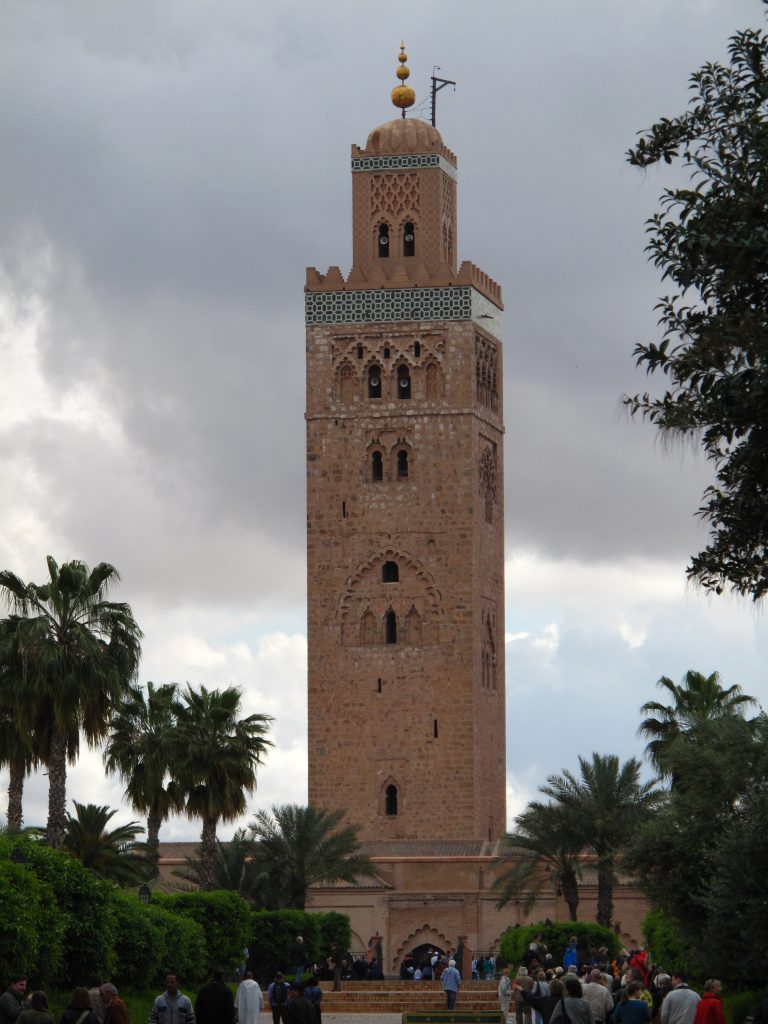
The square minaret of the Koutoubia Mosque of Marrakesh. A replica in Seville, Spain was converted into a cathedral when the Muslims lost Spain in 1492. Photo: M. C. D’arcy
Around the world a medley of minarets adorn mosques of the Muslim faith. Some seem quaint and simple; others are thrillingly ornate, ethereal. The minarets in our vision will be the fascinating ones, those painted with reverence and entwined in history, art and nostalgia.
Manāra is the Arabic word for lighthouse. (English: minaret). Most minarets consist of a base, a tower and a gallery from which the muezzin delivers the athan (call to prayer). Locally the muezzin was, and is still, referred to as the Bilal.In old Cape Town this athan-call was referred to as: Bung (Bahasa Malayu) (Afrikaans – hy bang).
Islam’s first minarets were erected at the Umayyad Mosque in Damascus. Some say that the four square minarets had been part of the pre-Islamic building, probably from a Roman temple to Jupiter that had stood on that site. The original minarets were later replaced with Mamluk style towers adorned with their typical geometric patterns.
During the early Umayyad era the first minarets specifically built for athan were at the mosque of the Prophet in Medina. The four slender corner minarets were 25 meters high. In the eighth century they were refashioned by Umayyad Caliph al-Walid. Sadly, these are no longer extent. At about the same time the Umayyads built slender corner minarets around the Great Mosque (Gharam) in Mecca. They were slender towers, hardly conducive to calling the athan from.
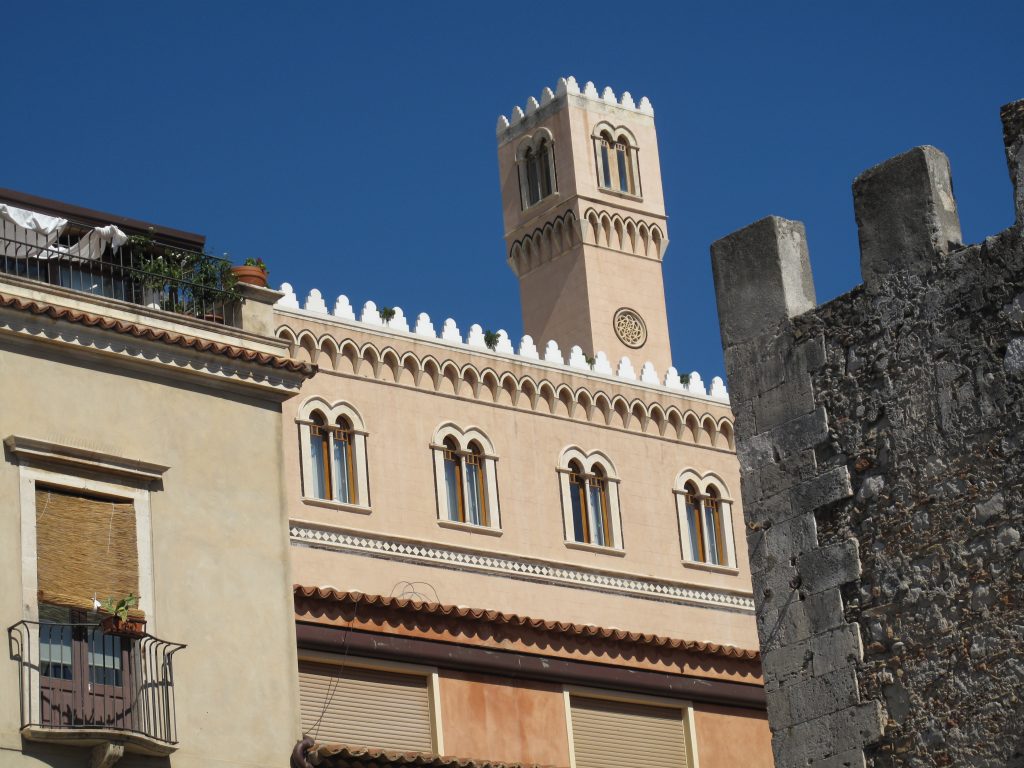
A minaret on the Greek island of Rhodes. This island was for a few hundred years part of the Ottoman Empire. (Photo: M. C. D’arcy)
Most early mosques had outside staircases to rooftop ‘sentry-box’ structures from which to call prayers. One such structure is at Bosra in Syria (built 720CE). With current intensive bombardment of the Syrian cities, one wonders if it is still there. In The Habibiyah 75th Anniversary Souvenir Brochure of 1980 there is a picture of the early Habibia mosque in College Road, Rylands with a rudimentary roof minaret with an outside stairway. (Incidentally, one of the first Imams trained at that nascent mosque was my maternal great-grandfather, Imam Hassan Jakoet (Pang Gasant) – (Hazrat Moulana Abdul Latief Qazi – Riaz Jawoodeen, Habibia Soofie Masjid Centenary Magazine, 24/8/2005, P27).
Pictured in a 1950’s postcard the Auwal Mosque in Dorp Street, Cape Town had a small minaret just above rooftop level. Now it is decked with a conventional style minaret.
The huge 9th century Samara mosque near Baghdad had a freestanding conical minaret with a spiral outside stairway for donkeys to carry the muezzin to the top. The impressive Mamluk Ahmad Ibn Tulun mosque I saw in Cairo has a mini-copy of this classic design. Mamluks were ex-slaves who were groomed for high positions as rulers or kings. Interestingly, the mosque was once sold for a vast sum. To the disgust of the buyer, the seller then demanded extra money since the minaret was built free-standing a short distance from the mosque wall.
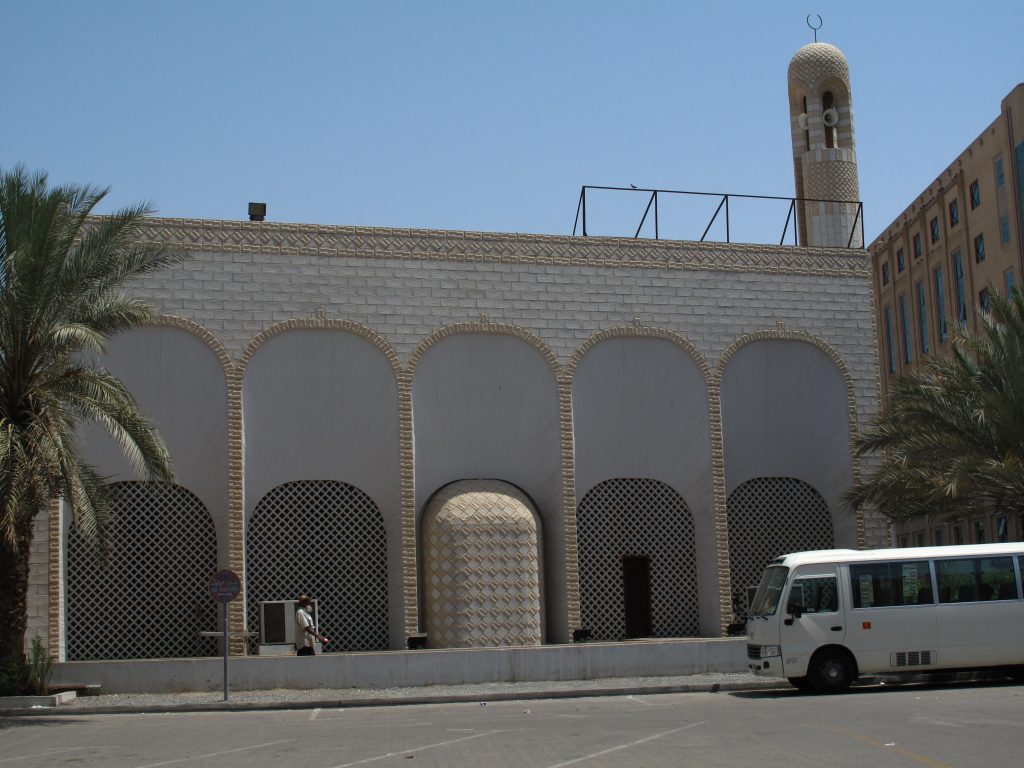
A mosque in Dubai. The ornate mighrab protrudes from the mosque wall. Photo: M.C. Dharsey
Minarets vary across the globe. Many of the mosques in Turkey are decorated with pencil-slim minarets capped with pointed metal spires. The number of minarets varies according to the size and prestige of the mosques. Mosques built for the caliphs have more minarets than local edifices. Some minarets of the Süleymanye mosque, built by supreme architect, Mimar Sinan, for of Suleiman the magnificent, sport very ornate decorations.
Moroccan minarets are mostly square and adorned with intricately-pierced ornamentation. The 77metre tall minaret of the Koutoubia mosque, completed March 10, 1198, and sited close to the world famous Jemaa El-Ifna souq in Marrakesh, sports this design. It was echoed in the Great Mosque of Seville, Spain. After the Muslim defeat in Spain, the grand mosque was turned into a Cathedral. The minaret was converted into a bell tower. Incidentally, the Koutoubia mosque was also known as the Mosque of the Booksellers, denoting the love of books in Islamic life almost a thousand years ago.
The famous Al-Qarawiyyin Mosque complex in Fes, Morrocco, founded by Fatima al-Fihri in 859 CE, has a beautiful square green-tiled minaret. According to Guinness World Records book, it is also the oldest continually functioning university in the world. And, it was founded by a woman. Of interest: ‘12th century scholar Ibn ‘Asakir (most famous for his book on the history of Damascus, Tarikh Dimashq) travelled extensively in the search for knowledge and studied under the tutelage of 80 different female teachers.’ (Century Welfare Association, Mauritius).
The opulent, recently built, Mohammed IV mosque in Casablanca juts out over sea. Its square minaret has a lift to transport the bilal up to the top. It also has a powerful laser beam that shows Casablancans the direction to the Kaaba in Mecca.
Fatimid Shiia Caliph Al-M-Mu’zz sent his Sicilian commander, Jawhar, to conquer Egypt. Jawar established the city of Cairo in 969 CE. In June, 972CE the first mosque complex was completed. Saladin Ayyubi changed the Shiia belief to Sunni.
I once had the privilege of ascending inside one of the Mamluk-style minarets of a Cairo mosque and feasted on the carved patterns of zigzags, geometric stars and floral bouquets of Mamluk art carved on the domes and the minarets of the mosque. Heavenly art! In 970 The Fatimid Caliph Al-Mu’izz li-Din Allah constructed the first mosque in Cairo: The Al-Azhar (Probably named after the Prophet’s daughter –Fatima Al-Azahra –Wikepedia: Muslim Heritage). It evolved into the second university complex in the world. Today Cairo is known as: The city of a thousand minarets.
Moving east to mosques through North Africa and onto the Middle East: North African clay and wood structured mosques have either no minarets or rudimentary minaret features. These mosques have to contend with the adverse weather and the distortions of malleable clay. They have to be restored almost on a yearly basis. Clay also restricts the building of tall minarets.
Middle-East, Arabian and Gulf states mosques tend to have spire-minarets with onion-style domes at the top. This is noted particularly in Persian and Indian designs. Further east, in China the minarets are pagoda-styled or are often completely absent, as with the older mosques in the Indonesian archipelago.
A medley of quirky and cute, old and new minarets of Cape Town and its surrounds will follow soon.
© Copyright M. Cassiem Dharsey (D’arcy) 9 January, 2017