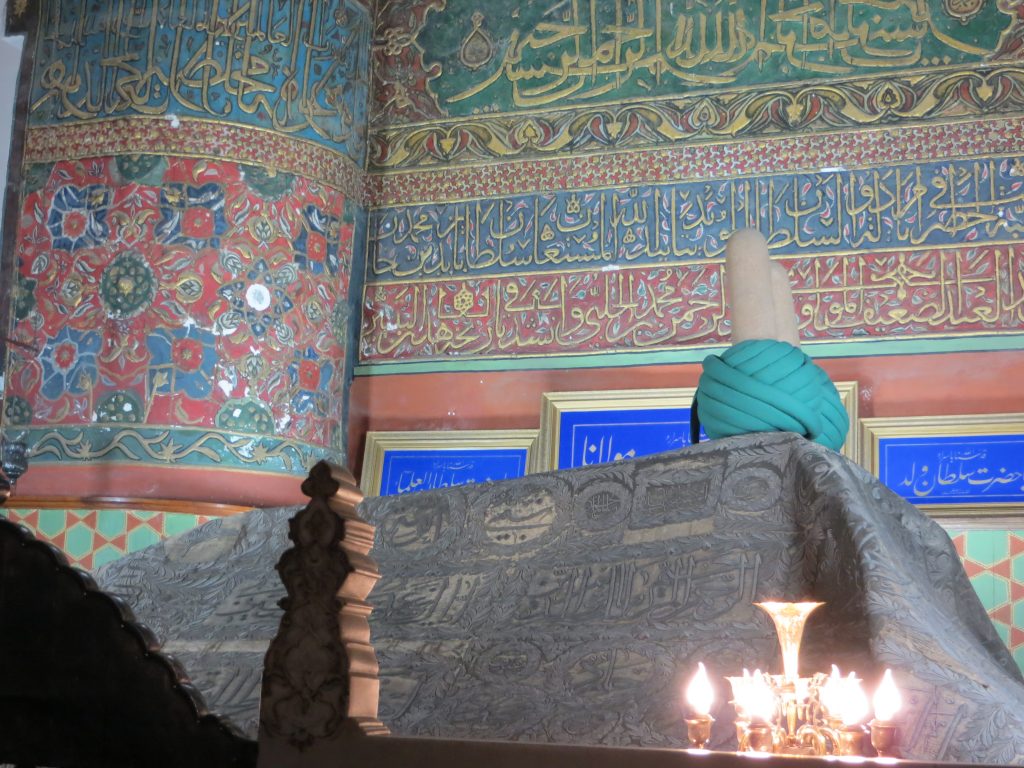
The green fluted edifice jutting from the roof of Sufi Jalaludin Rumi’s mausoleum in Konya, Turkey, is crowned with a green tiled cone; it is from the hand of the greatest architect of the Ottoman Empire, Mimar Sinan. Never-ending crowds stream past Rumi’s tomb, ornately housed, but intimately attached to the very house that Rumi lived in and practiced his ethos of the Divine and the self synergistically entwined. Controversial? Yes, even in his living days he was clothed in absolute adoration and bitter acrimony. Legendary Sufi and judge, Nasrudin Hoça, who lived close by in Akşerhir, detested him.
Droves of tearful adherents pray at his grave seemingly to beseech celestial favours and intercession for a thousand maladies. They adulate the ground he walked on, ogle the clothes he wore (now displayed in viewing cases) and even kiss the glass surrounds of a small casket purportedly containing a smidgen of his beard. I find the common obsessive reverence to dead men’s hair quite bizarre.
What struck me was that this picture of fervent supplication of a divine is so universal across all social, religious and ethnic divides. Cape Town is no different; only the names of the sanctified are changed. Great men and women should be lauded, respected, never worshipped. But I can understand. Hopelessness is tragic. When there are no medicine for ailments and no solution to problems, the desperate reach out for desperate solutions and grab at celestial favours from whatever direction they may come. That is human nature. Rumi said: ‘When we are dead, seek not our tomb in the earth, but find it in the hearts of men.’
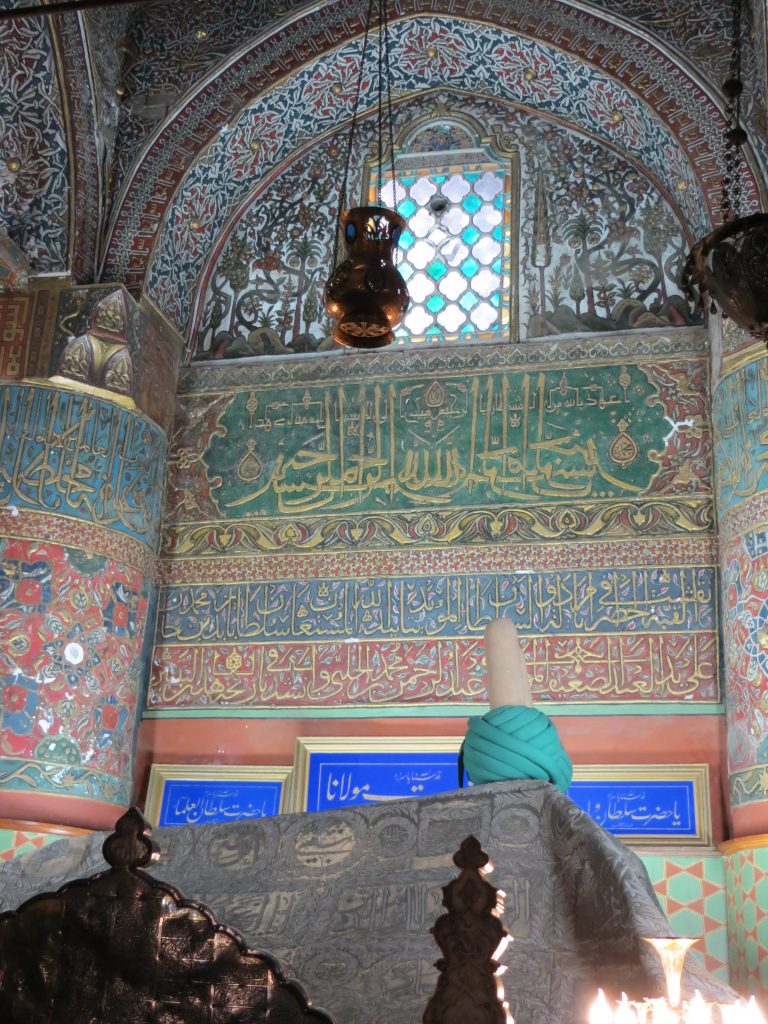
Rumi’s ornate grave adjacent to his house. The great Ottoman architect, Mimar Sinan, redesigned Rumi’s mausoleum.
In 2008 a more comprehensive article of mine on Rumi appeared in Muslim Views, so I’ll just sketch a background picture. Jalaludin Muhammad Rumi was born 1207CE in Balkh, now in Afghanistan. With the savage Mongol invasions the family fled and lived in many places until they reached Konya in Seljuk Turkey (then known as Rum) where they settled. Rumi died in Konya in 1273CE. He wrote his iconic opus Mathnawi in Persian. When Shams ad-Din, a very close friend of Rumi inexplicably vanished he wrote a 30,000 verse poem: Lyrics of Shams of Tabriz.
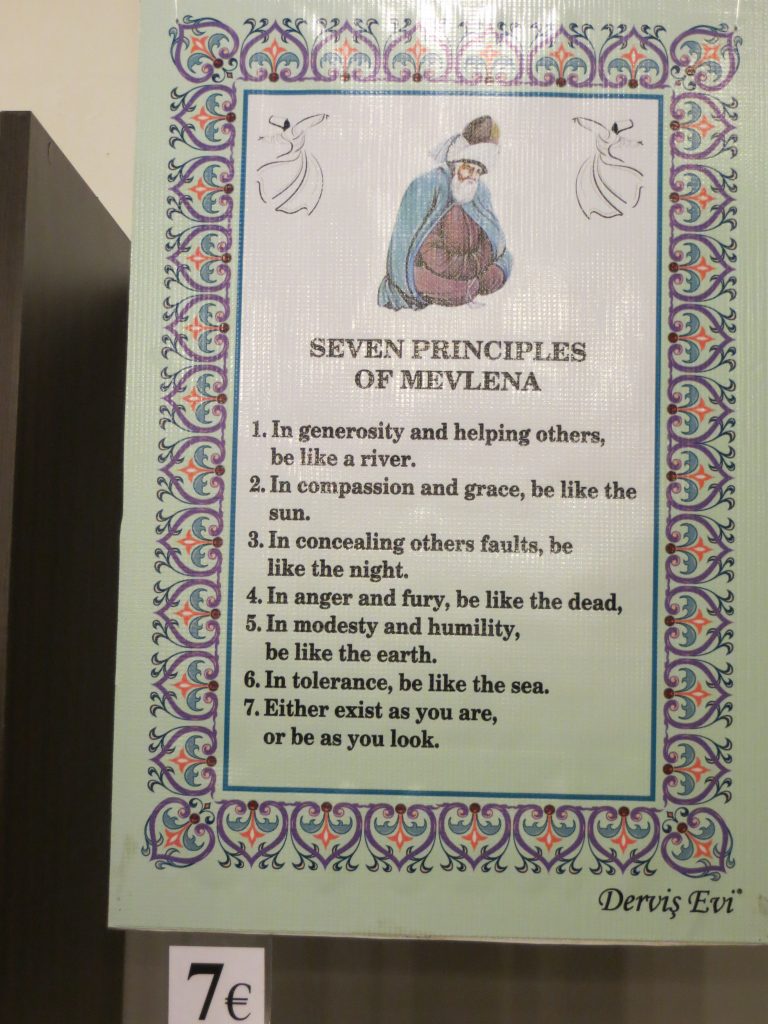
Rumi’s aphorisms guiding humanity to righteousness still apply.
Rumi’s son, Sultan Walad, founded the Mevlevi Order of the Whirling Dervishes, famed for their Sama Sufi Dance.
We attended a performance of the Whirling Dervishes in an underground cave in Cappadocia. The rituals, headed by a black-cloaked Ustad (teacher), were complex. The devotees, coifed with tall fezzes and dressed in long voluminous white skirts, whirled in a determinate pattern with one arm raised to the sky and the other down to the earth, apparently conducting heavenly energy down to earth. The music was hypnotic. The whirling spun faster and faster inducing a trance-like ecstasy. It was so evocative of the ancient Khoisan trance-dances of South Africa.
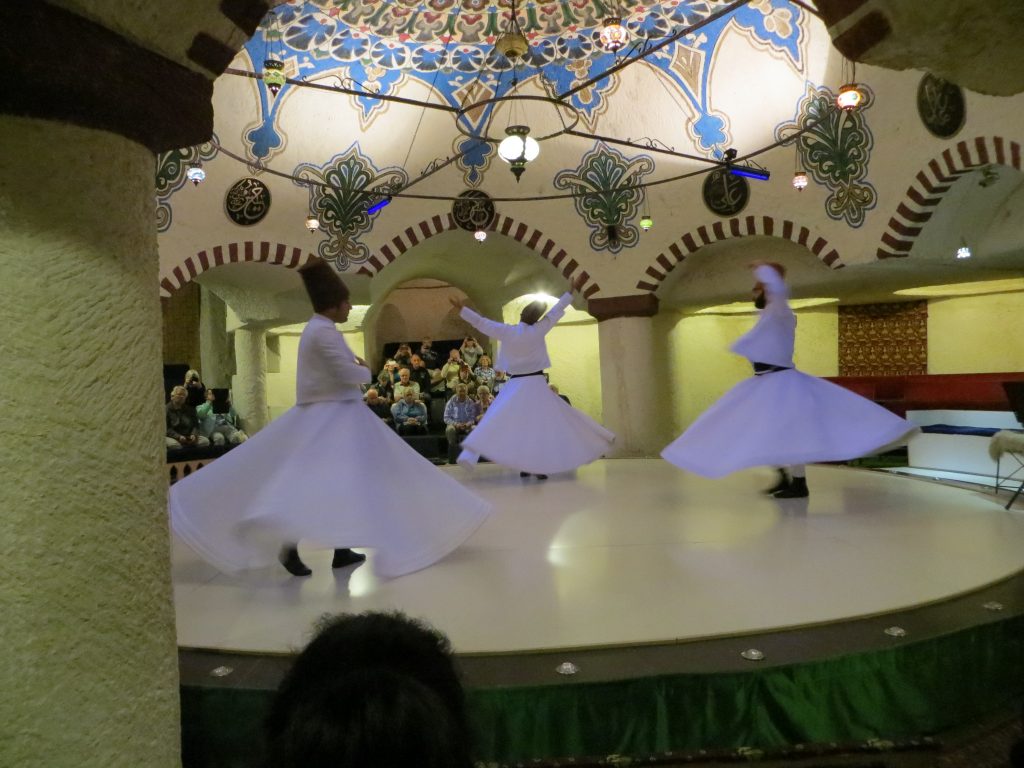
The Whirling Dervishes ceremony performed in a subterranean cave in Cappadocia. It was Rumi’s son who started the Mevlevi Order of Sufi-Dervishes.
Near the ruins of Ephesus we viewed the ‘House of the Virgin Mary’. According to lore, when the Christians of Jerusalem were persecuted after the death of Christ, she fled to the busy port of Ephesus on the coast of current Turkey. During unrest in Ephesus, she went to live in the hills above the town where she subsequently died. There is no burial place evident. However, some biblical authorities say that she never left Jerusalem.
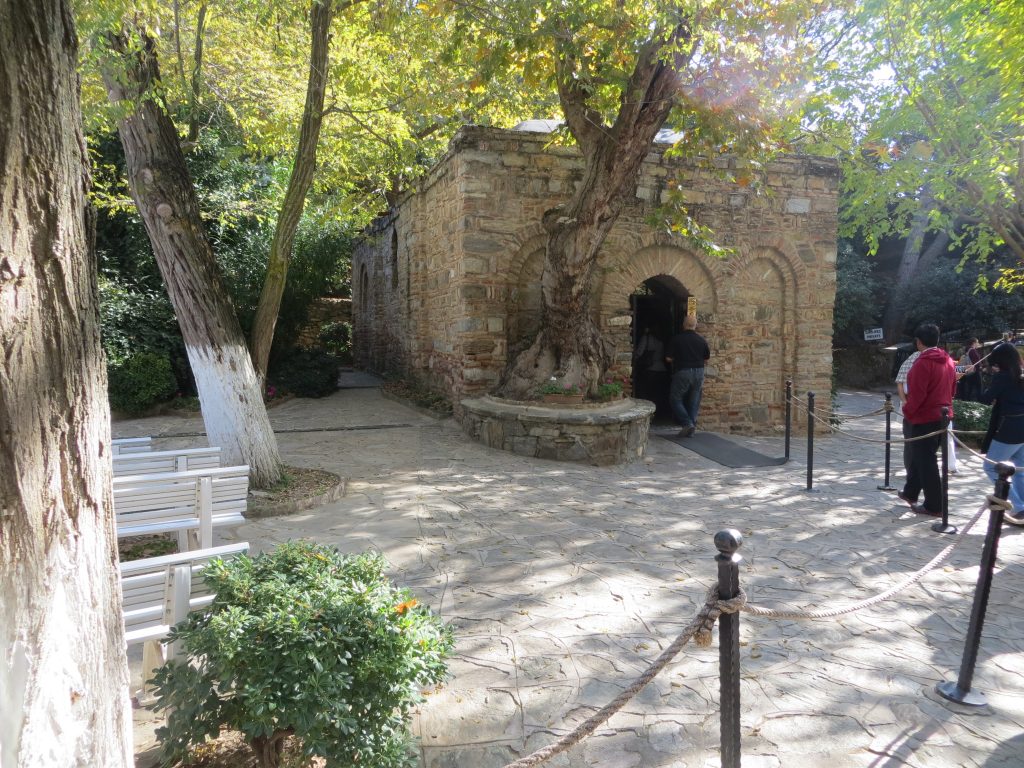
The purported Virgin Mary’s House sited in the hills near Ephesus, Turkey, now a place of pilgrimage and veneration.
In mid-nineteenth century a German nun, Anne Catherine Emmerich, dreamt of the location of the ruined house of the Virgin Mary near Ephesus, and despite the fact that there were quite a few ruined houses in the hilly surrounds, it was “found”. The Vatican investigated her dream but did not authenticate the house one way or the other. However, many Popes have visited the site of ‘The house of the Virgin Mary’. Recently Anne Emmerich was beatified as a saint. The house was restored and it is now a place of veneration where believers light candles and invocate fervent prayers. In the small house, elevated above an altar, is a small dark-coloured effigy of the Virgin Mary. Strangely, her hands were missing. On a nearby wall, worshippers attach supplicating messages by the millions, just as in the Jewish Wailing-Wall in Jerusalem.
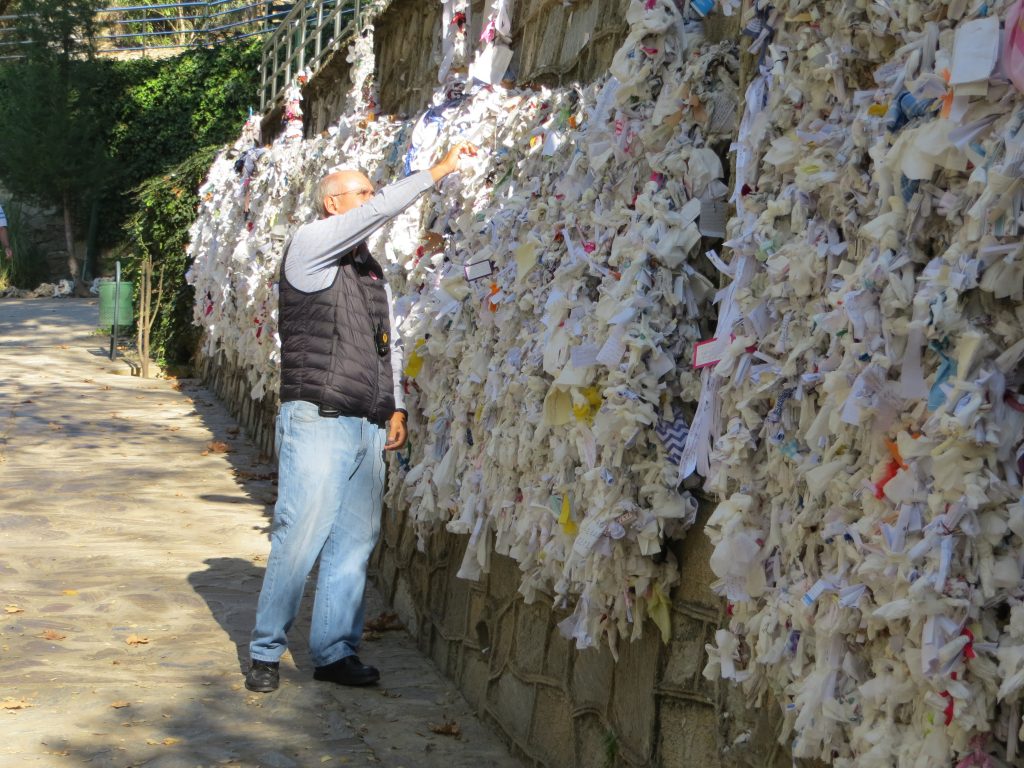
The wall of prayer notes similar to the Jewish Wailing-Wall in Jerusalem
The above scenario reminded me of the time in 1968 when the late Achmat Davids and I started our researches into the origin of the Muslims at the Cape. We visited the tombs of the Kramats (holy men) around the Cape Peninsula and interviewed people who frequented these tombs. Apart from the historically verifiable individual sages buried in specific graves and mausoleums, we visited other ‘graves’ that dotted the scene. These were often attributed as the burial places of unknown individuals divined as Kramats via dreams. Some of the stories were tenuous at best. Recently I saw a somewhat hidden brick-enclosed grave that had mushroomed in the fynbos on Signal Hill. A small attached sign simply said: Unknown.
Mausoleums, such as that of Rumi, are often places of beautiful art; others are simple like the purported House of the Virgin Mary. They remind us of the past, of great historical events and personages that determined belief and veneration. But there are others. ‘Scourge of the Earth’ Mongol, Timur, the lame, sacked and pillaged Baghdad and crippled the Muslim Empire. He became a Muslim and built a magnificent burial tomb in Samarkand. He, and others of his ilk, believed that they were saviours of the world, but sowed death and destruction. Of interest is that his body was exhumed by the Russians in 1941, even though Timur’s tomb was inscribed with the words, “When I rise from the dead, the world shall tremble.” His casket was also inscribed: “Whomsoever opens my tomb shall unleash an invader more terrible than I.” In any case, three days after Archaeologist Gerasimov began the exhumation, Adolf Hitler launched Operation Barbarossa, the largest military invasion of all time, upon the Soviet Union.” Millions of Russians were slaughtered. “Timur was re-buried with full Islamic ritual in November 1942 just before the Soviet victory at the Battle of Stalengrad” (Wikipedia) No art can cover such inequity.
© Copyright: M. C. Dharsey (D’arcy) 26 June, 2016 WC: 1009