
The Hagias Sophia in Istanbul is doubtless a gem of architecture. Built as a church in 537CE by the Byzantines, it was the biggest church in the world. In 1453 Mehmet II conquered Constantinople and converted it into a mosque. With the secularisation of Turkey in the nineteen twenties, the mosque was turned into a museum. It is now being restored to its initial glory.
My interest in the Hagias Sophia goes way back to the nineteen fifties when, in my teens, I read Louis de Wohl’s epic book: The Living Wood. Of the couple of thousand books I have read since then I have always remembered the name and the magnetic historic-fiction tale it told of how the Roman Emperor Constantine’s mother Helena converted to Christianity and went to Jerusalem to find the ‘True’ cross on which Jesus was crucified and the nails that were used to pin him to the cross.
Historic research, however, is somewhat different. In the 4th Century Helena did go to Jerusalem and was confronted with three crosses. A test for the ‘True’ cross was done. A very sick person was taken to the first cross but she did not improve. Taken to the second cross, and again she did not improve. When confronted with the third cross she instantly got better. This cross was hailed as the “true” cross on which Jesus was crucified. Truth be told, this test would not pass muster with modern archaeological testing. On another visit to Jerusalem she found the three nails of Jesus’ crucifixion. Again, were these the real ones? No tests were done.
Helena was instrumental in the conversion of her son Constantine’s conversion to Christianity, and Christianity becoming the official religion of the Roman Empire. Constantine founded Constantinople (now Istanbul) and made it the Byzantine Eastern capital of the Roman Empire in the 4th century. Strangely, Helena’s skull is displayed in a small box in Triers Cathedral, Germany.
The Hagias Sophia was adorned with the biggest dome in the world, only surpassed a thousand years later by the famous artist, sculptor and architect Michael Angelo’s St Peter’s Cathedral in Rome. However, its dome was not perfectly round and the uneven weight caused some cracking of the walls and foundation. It was shored up by the great Ottoman architect, Mimar Sinan. He added a concrete bastion with a pencil-shaped minaret. The Hagias Sophia had a great influence on the Architecture of Ottoman mosques, particularly of the many masterpieces of Mimar Sinan and his pupils.
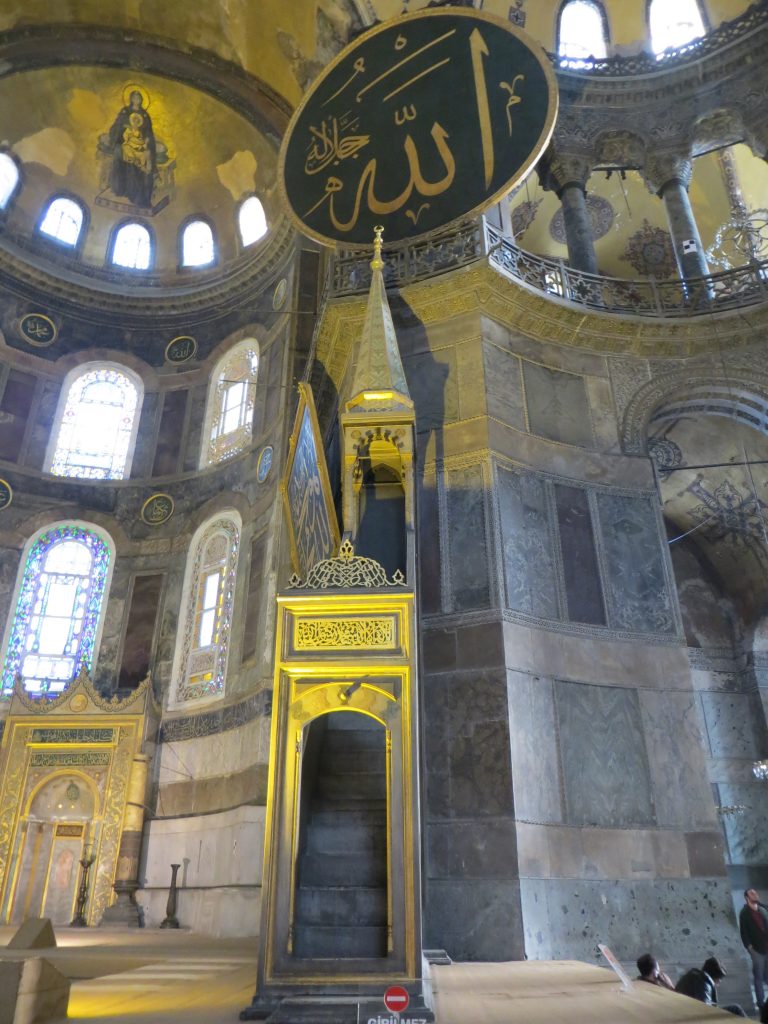
Interior of Hagias Sophia. Note Islamic mosque calligraphy and restored Christian church mosaics.
Restoration of the Hagias Sophia’s walls shows that when the church was turned into a mosque many beautiful religious mosaics were plastered over and huge Muslim Calligraphy plaques displayed to indicate a distinctive Islamic tone. Some of the figurative restored areas seem as if the original mosaics were adorned yesterday.
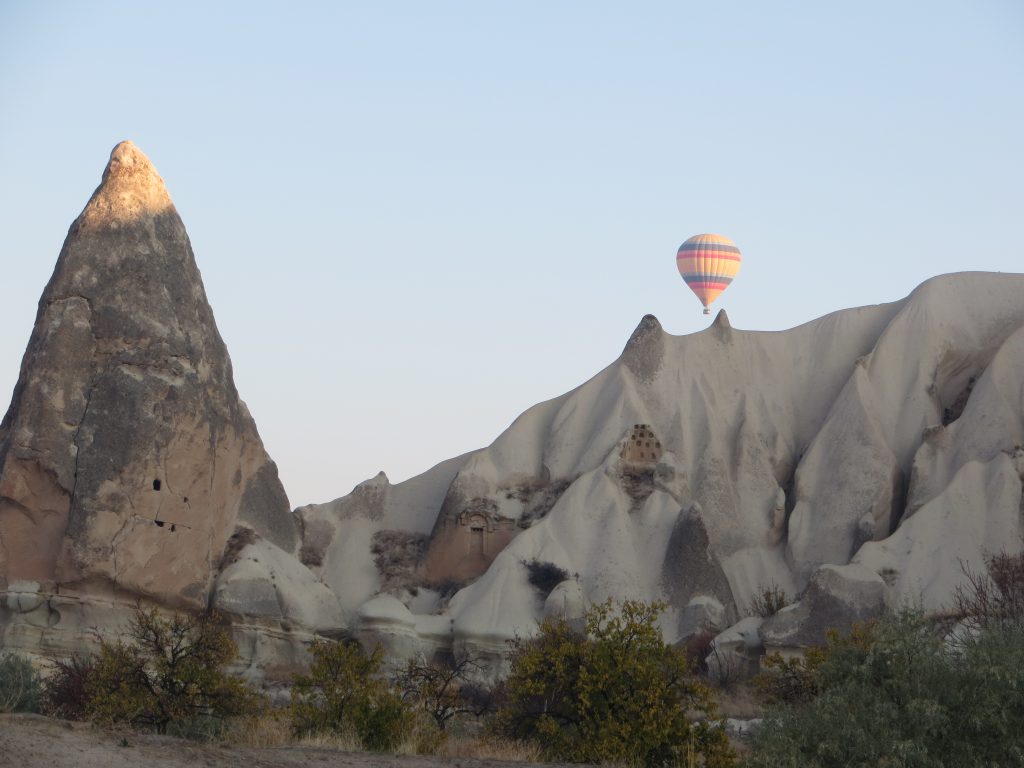
In life there’s art by man and art by nature, and then there’s a combination of both; and that’s an exciting experience. Deep in the heart of Anatolia are the spires and caves of Cappadocia; a weird-looking landscape as if culled from some intergalactic comic. In ancient time when the earth was hot and bothered with many spouting volcanoes, lava and tuff spewed from the red hot earth. These solidified into candle-like spires. With erosion the solid cores were exposed to the earth in a eerie vista of pointed spires and rounded mounts. There is evidence that ancient man excavated some of the formations, but what we see today is the work of modern man, who burrowed into the rock, tunnelled and devised large open caves and rooms to live and pray in; cool in the hot summers and warm when the snows cover the landscape in a fairytale wonderland.
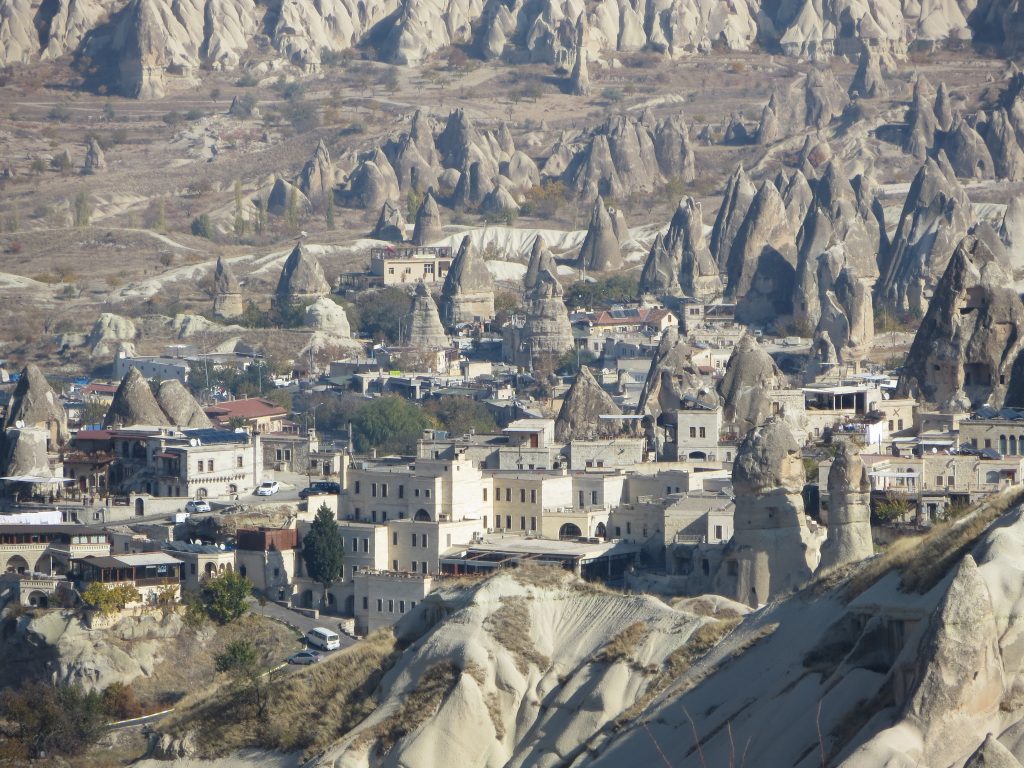
Cappadocia vista of stone excavated spires and houses.
Anatolia was once occupied by the Greeks who built many cities of which Troy was an example. It then became part of the Roman Empire. The bustling city of Ephesus was a prize Roman-plum. Biblical St Paul once lived in Ephesus. His Damascus Road vision and blindness episode are intimately associated with the ‘Trinity’ concept f the Divine. The Romans were polytheists and persecuted the early Christians. They fled to the interior and to Cappadoccia where they hid in the many caves of the area. With time they enlarged the caves into spacey rooms with interconnecting tunnels. Many of these mini-churches were adorned with beautiful mosaics. Man-made art synergised with landscape art. Monks also used the cave structures for the abbots and for worship ceremonies.
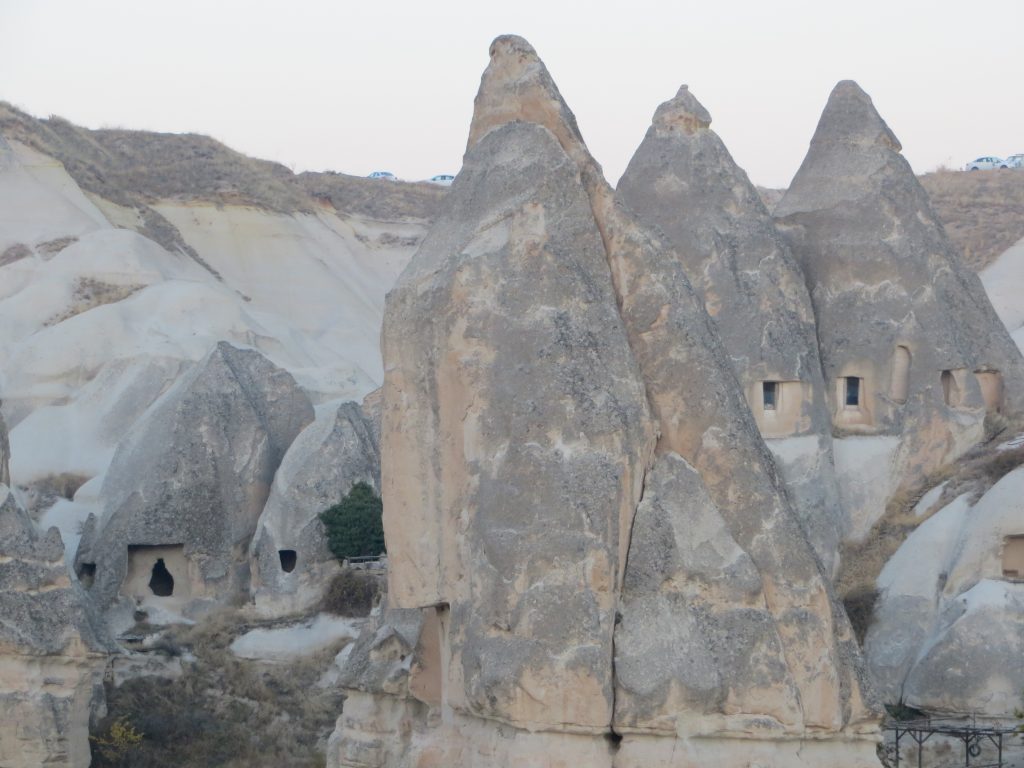
Today one of the subterranean caves is used as a tourist venue for the enigmatic Whirling Dervish ceremonies to which we were transported at neck-break speed down the hills and round the curves by an insane tourist car-driver. With bated breath we prayed more fervently than all the Whirling Dervishes ever did.
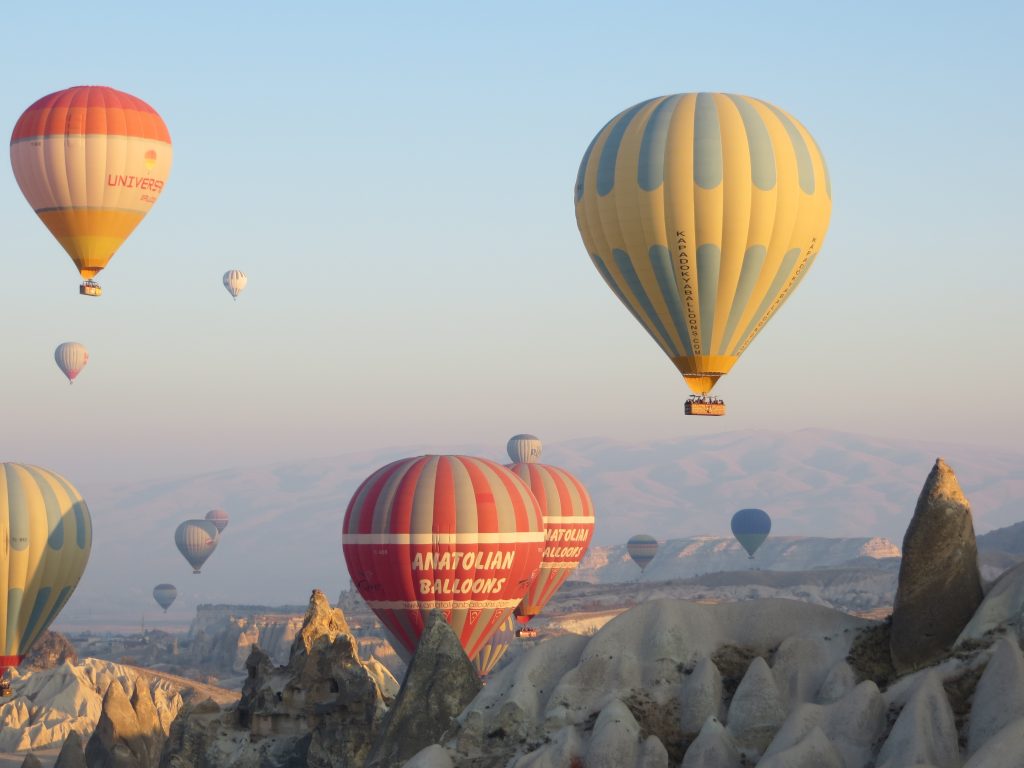
Cappadocia Hot-air balloons dancing in the sunrise air.
Before sunrise, on a blistering cold morning, my son Mukhtar, daughter Shameema and I were whisked to an open field on the outskirts of Cappadocia. My fear of heights made me shiver more than the icy cold atmosphere did. I pleaded and begged to stay on mother Earth but I was placed upright in a compartmentalised wicker-basket from which I could not escape. And then the flames roared. I nearly jumped out of my pants and suddenly we were yanked into the air by a big brightly coloured balloon. When my eyes opened we were sailing over the valleys, hills and spires of Cappadoccia. Ooohs! and Aahs! drowned out my prayers. The balloonist let out some air from the balloon. We drifted dangerously close to the sharp pinnacles of the rocky spires. The balloonist smiled wickedly. A thousand doahs and curses upon him did not help. And when the torture was over he plonked us down right on a small trailer bed; marvellous steering. I did not drink the celebratory glass of apple juice.
(Note: Featured image: Hagias Sophia exterior, Istanbul. Built 537CE It had the largest dome for a thousand years. )
© Copyright M. C. Dharsey (D’arcy) 10 August, 2016