
A journey of discovery is sterile and insipid without an inkling of what the eyes are seeing, what music the ears are hearing, and what rich and wondrous tales of history that the intellect can savour.
In a 2013 census, Turkey had over 82 thousand mosques. Our tour-guide snidely commented: ‘That’s too many.’ Perhaps so for a follower of the rigid secular state that the autocratic regime of Mustafa Kamal Attaturk instilled following the post World-War I collapse of the Ottoman Empire Caliphate in 1924.
Before World War I Turkey tried to form a protective alliance with Britain, France and Russia. They were rejected. Turkey then joined Germany in World War I. During the war, the notorious Sykes-Picot agreement of 1916 was signed by the Western Allies. Influenced by strong Zionist lobbying, it unilaterally outlined how the Ottoman territories in the Middle East and Palestine would be shared between, Britain, France and Italy after the war. This was invoked after the 1918 defeat of the German-Turkish Alliance.
The Post World War I Turkish regime was faced with a chaotic scenario of wars with Greece and widespread civil unrest. The country was also essentially bankrupt. Draconian changes were instituted in all walks of life, including state control of religious practices, Sharia-law was essentially scrapped, education modified to western ideals – with emphasis on science and technology. A change from Arabic Script to the Latin alphabet was instituted within three months. Gender equality, social norms and dress were enforced (There was even a Hat law dictating that males had to wear Western Hats, not turbans or fezzes). Turkey went full-steam into industrialisation and westernisation of personal and societal norms.
The Ottoman Caliphate was abolished in 1924 and the last Caliph, Sultan Mehmed VI, went into exile n San Remo.
Many critics said that changes went too far, and too quickly, but they were sidelined and purged.
Turkey is still a secular state, but is now going through a loosening up of state control of religious practices and institutes, and shifting slowly to one of personal choice. The majority of Turks are Sunni Muslims. Travelling through the countryside the sight of pencil-thin minarets is omnipresent in every city, town and village encountered. The minarets’ call to prayers still resonates through Istanbul five times a day.
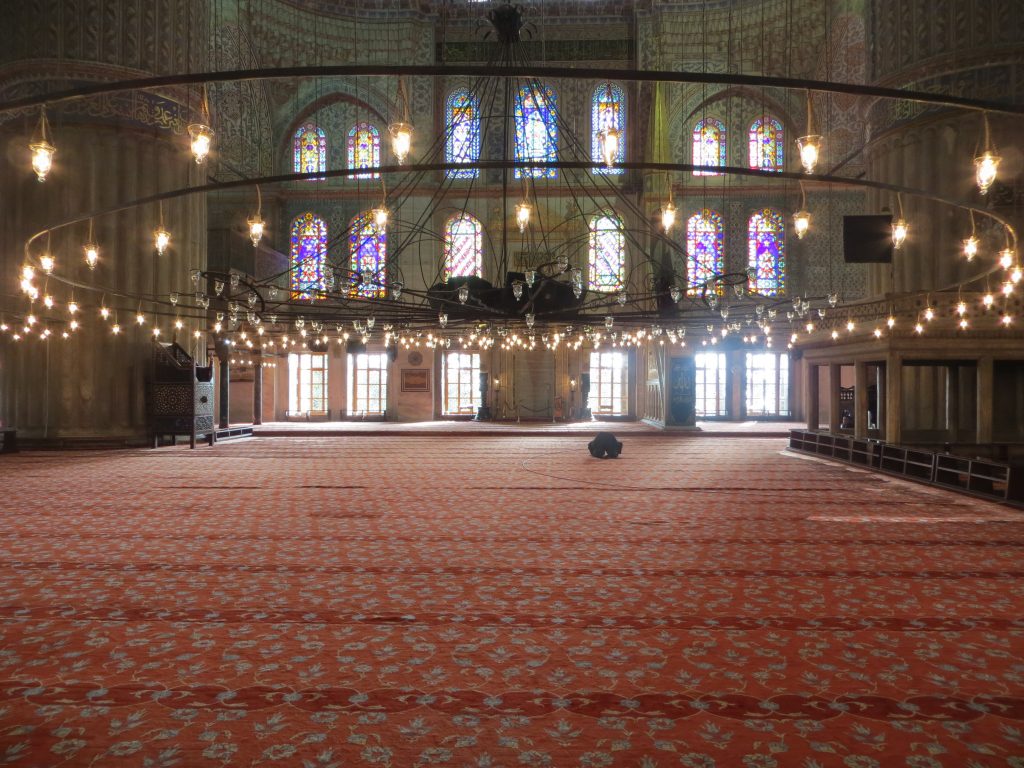
Excepting Mecca and Medina, probably the most famous mosque in the world is the ethereally beautiful Sultan Ahmed Mosque- Blue Mosque- of Istanbul. Over the years, Western Orientalists have cloaked it with an aura of mystique and romance. Of literal romance: on a previous visit, I saw a disrespectful French-speaking couple smooching in the mosque. They were promptly ejected. But mystique and historical morsels it has in bundles. Blue Mosque’s builder, Sultan Ahmed I, and its architect, Mehmet Agha, certainly had eventful lives.
Sultan Ahmed was 14 years old when he came to the throne as the 14th Ottoman Sultan. He reigned for 14 years and died at the age of 28yrs (2x14yrs) of typhus. The young Sultan was politically astute and re-codified many administrative laws. He was a poet of note, as well as a brilliant rider and fencer. A multi-linguist, he spoke Arabic and Persian fluently. More conservative than some of his forbears, he tried to enforce the prohibition of alcohol, the regular attendance of mosques on Friday, and the proper paying of Zakaat (compulsory Islamic charity) to the poor. Despite this, his short reign, from 1603 to 1617, saw the steady decline of the Ottoman Empire. He is best remembered for the construction of the Sultan Ahmed-Blue Mosque, but was reviled for using the fiscus to finance the extravagant construction of this Sultanic architectural gem; previous Imperial Mosques were financed from the booty of conquests; but military-weak Sultan Ahmed lost lucrative parts of the Ottoman Empire. (Was the Blue Mosque his Nkandla scandal?)
Once in an era, a soul of genius flares across the skies; and even when the superstar fades, he or she may live on for a thousand years in the work of his students and admirers. That once-in-a million architectural genius was Mimar Sinan, master architect of the Ottoman Empire that once included Asia Minor, chunks of the Middle-East and Arabia, North Africa and extensive territory in Europe to the very gates of Vienna. Mimar’s brilliance still radiates throughout the Süleymanye and Edirne Mosques. As we shall see, it also touches the Blue Mosque, and dwell in many other mosques and monuments across Turkey and beyond. In the near future we shall write more about Mimar Sinan; a superstar worthy of hyperbole.
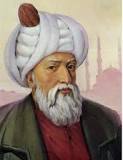
The architect of the Blue Mosque, Sedefkâr Mehmed Agha, born 1540 CE in Albania, then part of the Ottoman realm. Like many of the ‘great ones of distinction’, he ran through a panoply (dazzling array/collection) of different fields before he landed up in architecture. In 1563 he migrated to Istanbul and joined the Janissary corps (the Protectors of the Sultan). Six years later he studied music. His next vocation was as a specialist mother-of pearl inlay artist (a Sedefkr). This lasted 20 years. He constructed a commissioned walnut wood throne, inlaid with tortoise-shell and nacre (mother-of pearl), for Sultan Ahmed I, that can still be seen in the Topkapi museum. Following this, he studied architecture under the tutelage of the great Mimar Sinan. He succeeded in becoming first assistant in charge of Mimar Sinan’s office when his teacher was absent. A gift of a Koran Box to Murad III smoothed his way to being appointment to the prestigious title of Kapici (The Sultan’s Gatekeeper).
In 1586 he was appointed to complete the Muradiye Mosque in Manisa that the infirm Mimar Sinan had started. However, Sinan died in 1588 at the age of 91years. Much to his disgust, the Grand Vizier (akin to Prime minister) appointed Davut Ağa, Master of Waterways, to the post of: Sultan’s Architect. (Sounds familiar to us in South Africa) When Mehmed gave the Sultan a richly decorated quiver, he was appointed as: Bailiff. (It seems that nothing still works as well as greasing palms) He went on to become Inspector of Works and was then appointed Master of Waterways by Sultan Mehmet III. In 1599 Chief Architect Davut Ağa was executed (It seems that in those days it was dangerous times to be an incompetent architect). Another architect, Dalgiç Ahmet Ağa, was appointed Chief Architect. He built the large tomb of Sultan Mehmed III in the grounds of the Hagia Sofia Mosque. In 1606 Mehmed Agha at last became chief architect and spent most of his time from 1609 to 1616 on the erection of the Blue Mosque of the young Sultan Ahmed I, who commissioned the Blue Mosque when he was only 19 years old. Sultan Ahmed, himself, sometimes physically helped in the construction of the Blue Mosque. Both the Sultan Ahmed, and his architect, Mehmed, died shortly after the completion of the Blue Mosque.
Architect Mehmed died 1617. Before he died, he had a book ghost-written by his biographer, Cafer Efendi, on current architectural theories, architectural training and his methods of construction of mosques. Also, the day to day construction progress, changes in architectural elements, as well as costs, were notated in eight volumes which are still extent in the Topkapi Palace library. So, thanks to Mehmed’s foresight, the erection of this masterpiece of Ottoman architecture is very well documented, unlike so many other heritage mosques and monuments all over the world.
The original building had mosque and madrasa sections, a hospital, a market-place, a primary school and the burial place of the founder Sultan and his family. These were destroyed in the 19th century. The Blue Mosque had six tall minarets which, according to apocryphal stories, outraged the clergy, for the Holy Mosque in Mecca also had six minarets, which could not be superseded. The mistake came as a result of a misinterpretation of the sultan’s decree for the minarets to have gold (altin) ornamentation, not six (alti) minarets. To placate the clergy, another minaret was added to the Meccan Haram Mosque.
The Blue-Mosque has a quiet delicacy of décor that is unique. Its striking blue Iznik tiles glow; the product of a lost secret of clay and quartz mixture, that makes it unmatchable. Over the years some of its eponymous blue ceramic tiles have been prised off and stolen; each of them irreplaceable, for tile colours cannot be matched from batch to batch. The intricate decoration and use of specific colour-pigments and length of firing in a red-hot kiln will always differ. Replacements will stand out and disrupt the beauty of the whole tile-face.
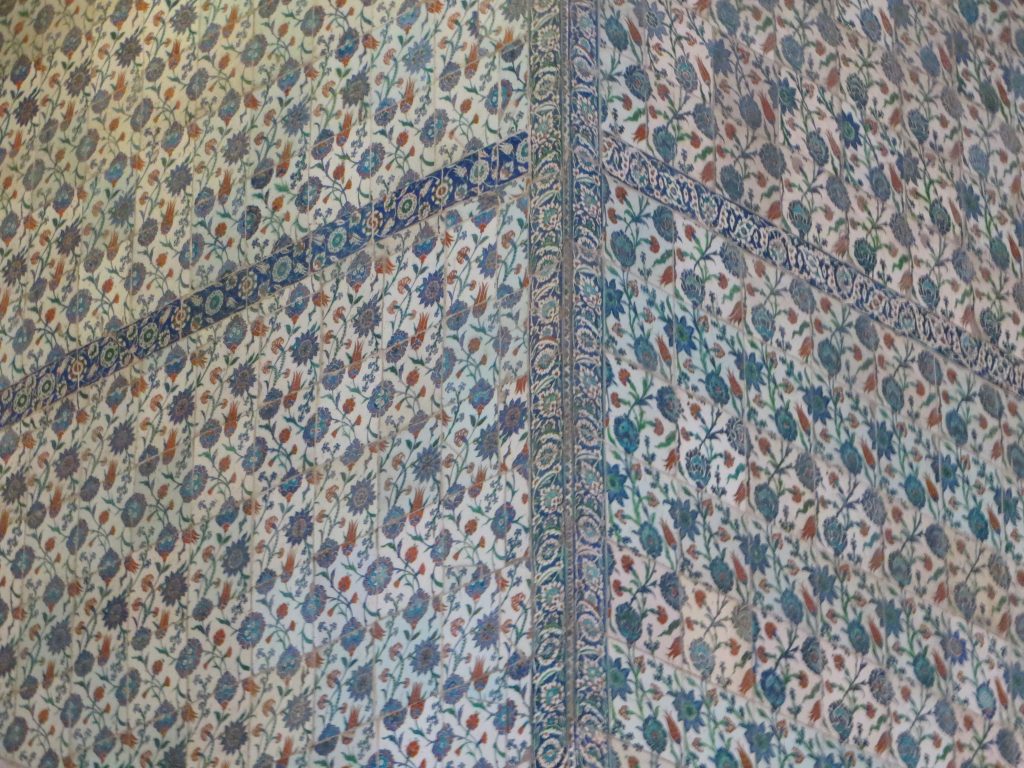
The Sultan Ahmed Mosque has over 20,000 Blue tiles, decorated with flowers, fruits, cypress trees to remind the worshipper of heaven. It is these tiles that give its name: The Blue Mosque. The 260 windows that pierce the dome’s drum and the walls originally held stained Venetian glass. The outside is not blue, but grey. The exterior fluted large central dome and the array of semi-domes provide a symmetrical cascade of roofing that is very pleasing. Its six pencil-thin minarets frame the building to perfection.
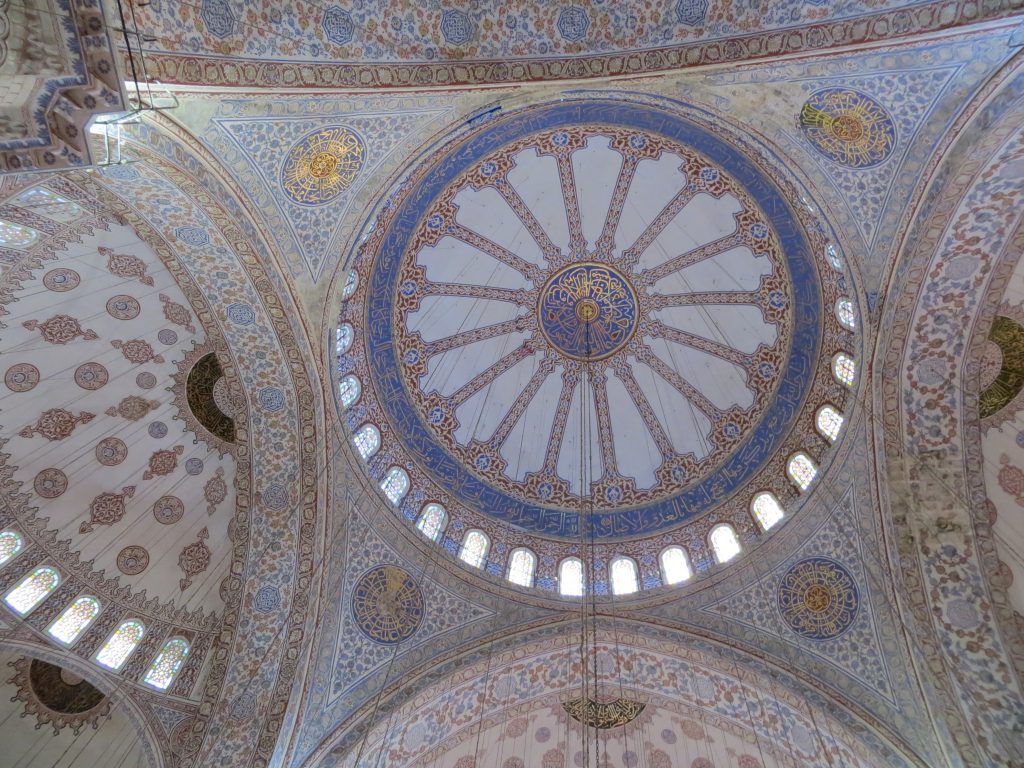
The Central Dome and semi domes rest on gigantic fluted pillars that give the space character, and yet an intimacy. There is a raised marble platform especially for the Sultan and his family. It has a tall minbar from which formal lectures, such as Friday Khutbas were enunciated. An ornate wooden kursi stands to one side; this is an elevated ornate, wooden minbar-like structure from which an Imam, or others, can lecture or teach.
The breathtaking beauty of Sultan Ahmed’s Blue Mosque should be savoured slowly; it is architectural caviar. It matches the nearby superlative Byzantine Church, Hagia Sophia, built in the 5th Century; and then it has its own charisma; a magic charm right out of the tales of divine splendour.
(Note: Featured Image: View of the six-minaret Blue Mosque of Sultan Ahmed and his architect. Mehmed Aga (Photo: © Muhtar Dharsey) Spellings of names and places differ from source to source or sometimes in the same source!)
Spellings of names and places differ from source to source or sometimes in the same source!)
© Copyright: M. C. Dharsey (D’arcy) 2-1-2016